

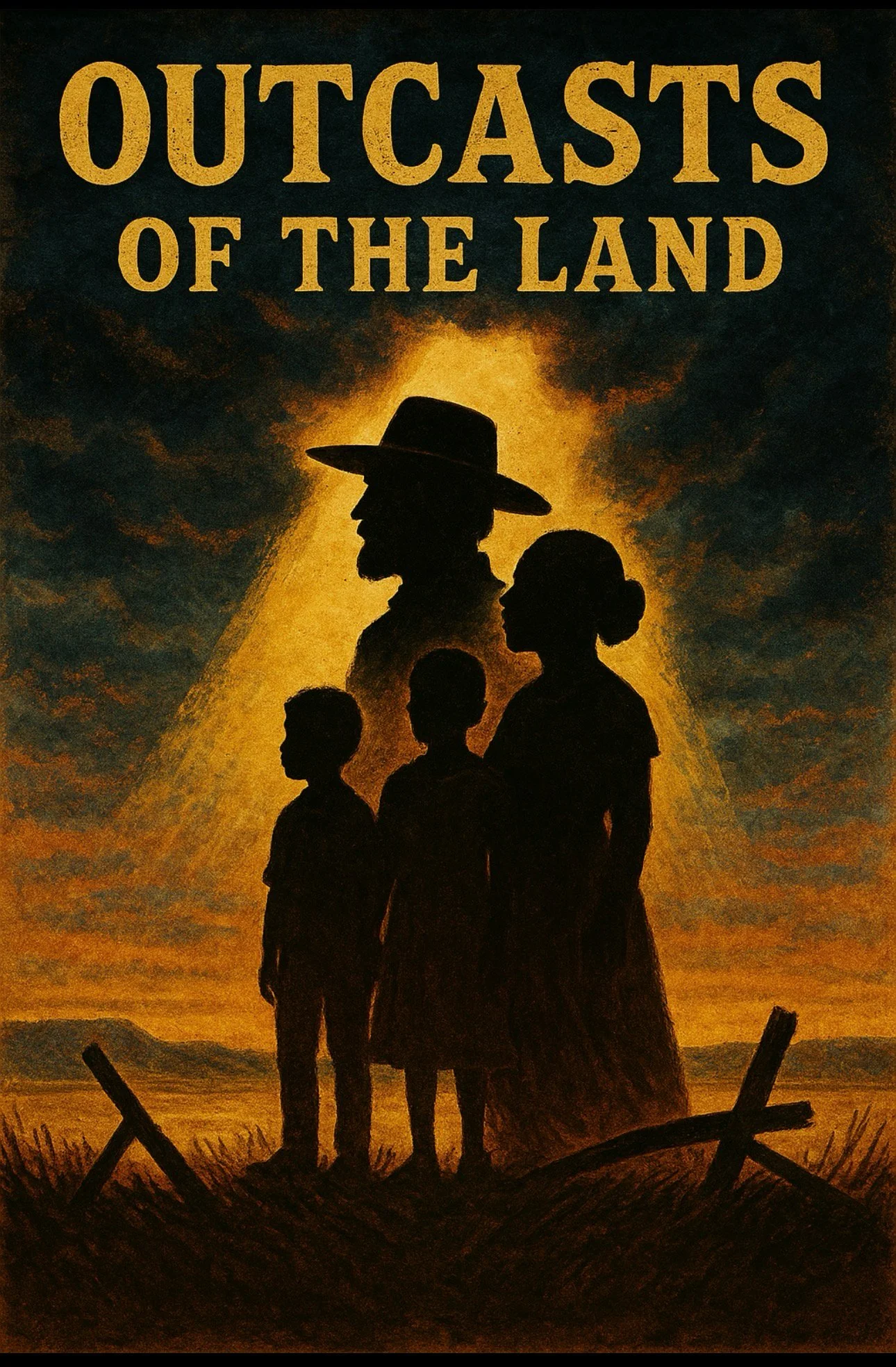
OUTCASTS OF THE LAND
A Multi-Format Historical Work.
A primary narrative work presented across stage, film, and literary forms
HISTORICAL ARTS COLLECTION
PRIMARY WORK
A Multi-Format Historical Work. (Stage • Film • Narrative Series)
A descendant-authored work examining the lives of John Ferdinand Webber and Silvia Hector Webber through performance, narrative reconstruction, and archival interpretation.
A story shaped across forms.
A narrative carried through archive, performance, and memory.
A work that moves between record and interpretation..
Part of the Historical Arts collection within The Webber Chronicle.
ADDITIONAL WORKS
Secondary narrative works expanding the historical, legal, and emotional landscape of the Webber family archive.
These works function as companion interpretations to the primary narrative Outcasts of the Land.
-
WE DID NOT CROSS FOR FREEDOM — WE BUILT IT
A one-act play exploring land, survival, and self-defined freedom.
-
A One-Act Play of Law, Love, and Borderland Resistance
Inspired by the lives of Silvia Hector Webber and John Ferdinand Webber
Written from a descendant’s perspective
- NARRATOR (DESCENDANT) — Guides the audience through time; reflective, steady.
- SILVIA HECTOR WEBBER — A woman of quiet authority; resilient, perceptive.
- JOHN FERDINAND WEBBER — Principled, steadfast; chooses conscience over law.
- SARAH — Silvia’s mother; memory and loss.
- PRIEST (FATHER MULDOON) — Compassionate; speaks sparingly.
- CLERK / OFFICIAL — The machinery of law (may double roles).
- CHORUS(optional) — Voices of law, river, and time.
- Set: Three vertical fabric panels or light columns labeled or projected:
Mississippi • Colorado • Rio Grande
- Props: Ledger book, quill, folded paper (bond), lantern, cotton sack
- Sound: Low river ambience; wind
Soft river sounds. The NARRATOR steps forward.
When I began searching for my ancestors,
I thought I was collecting paper—
Everything that mattered in their lives
Cool blue light. A ledger opens. The CLERK writes.
Mom and girl inventoried separately.
SARAH reaches for SILVIA. The space between them widens.
The Mississippi carried trade and cotton—
and carried her away from her mother.
March tenth, eighteen nineteen.
River sound swells. Lights shift.
Family, Freedom Bonds, Legal Erasure
Warm light. SILVIA and JOHN stand near the Colorado panel.
I won’t live by a law that breaks a family.
The PRIEST steps forward, holding a candle.
In Mexican Texas, the law bent—
He signs. The CLERK countersigns.
The CHORUS reads as proclamation.
Then we’ll write ourselves elsewhere.
They move toward the third river.
Dusk light. Lantern glow. Cotton sack near water.
South, the river meant refuge.
Mexico did not return the hunted.
During the war, their land became shelter.
Freedom practiced before it was declared.
## EPILOGUE — WHAT THE RIVERS REMEMBER
All three river panels glow softly.
The Mississippi carried her from her mother.
The Colorado carried her into love.
The Rio Grande carried her into history.
I was never the law’s property.
And the currents that shaped her life
still run through all of us who remember.
- Format: One-act; adaptable for staged reading or museum performance
-
Format: One-Act Play Focus: Rio Grande settlement and self-defined freedom
Source Base: Descendant narrative + legal context
A Stage Monologue by Silvia Hector Webber (as told by a descendant)
---
CHARACTERS
SILVIA - A dignified woman of African descent, age 60–80. Speaks with calm strength and deep emotional clarity.
JOHN WEBBER - Appears only in memory sequences. Mostly silent.
ENSEMBLE(optional) — Silhouettes or pantomime figures representing:
- CRYER
- PRIEST (Fr. Muldoon)
- NEIGHBORS / CHILDREN
- FUGITIVES / SOLDIERS
---
SETTING
A bare stage.
A single rocking chair or bench.
A lantern or candle glowing beside it.
Backdrop projections may include:
- river silhouettes
- prairie trees
- oxen and ferry boats
- shifting maps of Mexico and Texas
- a starry night at the Rio Grande
Lighting shifts between Present(warm, intimate) and Memory(cooler, shadowed).
---
ONE ACT
Scene: “A Voice Across the River”
(Lights rise softly. SILVIA enters slowly and sits. She holds a folded document — the 1834 emancipation bond — in her lap.)
SILVIA(to the audience)
I was born into bondage, though I do not remember where.
My people say Louisiana.
Maybe Mississippi.
Spanish territory, back then.
But memory…
memory gets swallowed up when you’re taken too young to know.
(Blackout to memory: a young girl is dragged away; a woman’s silhouette reaches for her.)
Twelve years old —
and already sold twice.
First from my mother.
Then west.
West to a place they called Texas…
though Texas wasn’t Texas yet.
It was Mexico —
and the borders moved like water.
(A shadowed figure labeled *CRYER** appears — stern, silent.)*
The man who bought me called himself Cryer.
I do not speak his name often.
He brought me to a land where slavery was not supposed to exist —
but still did.
Mexico banned the importation of slaves in 1827.
Outlawed slavery entirely in 1829 under President Vicente Guerrero —
a man of African descent.
But slaveholders cried foul.
And Mexico…
Mexico gave Texas an exception.
(A pause. The light warms slightly.)
That’s when I met John.
(JOHN WEBBER steps into a soft light — gentle, quiet.)
A white man from Vermont.
A doctor by trade.
A soldier in the War of 1812.
He had fought battles in the cold north…
and somehow found his way to these hot, broken lands.
He saw me.
Not my skin.
Not my labor.
Me.
(SILVIA touches the paper in her lap.)
On June 11, 1834,
John filed my manumission papers —
and our children’s.
They still rest in Austin’s archives:
proof that a Black woman walked free in Texas
before Texas even took its first breath.
We married in secret.
The church refused us.
So we went to Father Michael Muldoon —
a renegade priest with a rebel heart.
(Silhouettes of a secret wedding beneath a tree.)
A marriage like ours…
White man. Black woman.
Illegal in the eyes of men —
but sacred in the eyes of God.
We built our home on Wells Prairie.
Planted crops.
Raised oxen.
Ran a ferry across the Colorado.
They called it Webber’s Prairie.
Later — Webberville.
(Soft pantomime of ferry crossings and family routines.)
But the Revolution came.
And with it — new laws.
After 1836, Texas became a Republic.
And its laws turned mean.
Manumissions now needed the legislature’s blessing.
Interracial marriage — outlawed.
Free Blacks — denied citizenship.
If we’d tried to marry then,
we’d have been jailed.
Or worse.
(Shadows: neighbors gossiping, children turned away. A stone thrown.)
Neighbors stopped visiting.
Told their children not to play with ours.
Some came by night with threats.
Others tried to take our land
through courts
and cowardice.
The government stayed silent.
But its silence…
was an answer.
By 1850, the Fugitive Slave Act was law.
Slavery now hunted across borders.
But we —
we had always been watching the river.
(Sound of slow moving water.)
We heard whispers.
Not of Canada —
but of Mexico.
South.
Where slavery had been abolished for good.
Our ferry became more than a crossing for wagons —
it became a crossing for souls.
(A silhouette leads someone into the dark wings — a fugitive escaping.)
They say Harriet Tubman guided people north.
I never met her.
But I believe we were kin in spirit.
Just as she led them up into freedom —
we led them down
under starlight
into Spanish words
that meant liberty.
We were called traitors.
Harborers.
Outlaws.
But we were never called liars.
(The light dims. A family packs to leave; a river crossing.)
When the danger grew too great,
we left.
We crossed the Rio Grande —
left behind the ferry,
the home,
the trees we planted.
And we weren’t alone.
Other Black families crossed too —
runaways.
Unionists.
Lovers whose only crime was loving against the law.
In Mexico,
we were outsiders still —
but we were safe.
(A single lantern glows, the color of refuge.)
During the war,
Union soldiers passed through.
Some found sanctuary in our home.
We watched America tear itself apart
from across the border.
I do not know
if I ever truly stopped running.
But I know this:
We built something.
A legacy.
A family.
A quiet kind of freedom
that crossed rivers
and outlasted chains.
(She rises. Holds the emancipation bond to her heart.)
They tried to write us out.
But you —
dear descendant —
You have written us back in.
(SILVIA exits. The lantern flickers once, then goes black.)
---
END OF PLAY
Educational Adaptations
These works translate the archive’s narratives into structured educational formats aligned with historical analysis and discussion
Adapted materials designed for classroom use, guided reading, and public interpretation.
Featured Classroom Resource
Based on Law and Love: Defiance Across Three Rivers
-
Format: Structured classroom script
Based On: Three Rivers (descendant narrative + historical timeline)
Focus Areas:
• Law vs. lived experience
• Borderlands identity
• Family and resistance
Use Case:
Ideal for classroom reading, group performance, or guided historical discussion.
-
Format: Annotated narrative edition
Derived From: Primary multi-format work
⸻
Key Themes:
• Archive vs. memory
• Moral decision-making
• Historical interpretation
⸻
Suggested Use:
• Independent reading
• Seminar discussion
• Comparative history analysis
👉 Button:
Open Guided Edition
-
Format: Thematic teaching framework
Core Themes:
Freedom and legal status
Cross-border identity
Family continuity
Resistance within legal systems
Suggested Use:
Lesson planning
Curriculum design
Interdisciplinary coursework
👉 Button:
View Teaching Guide