

WE DID NOT CROSS FOR FREEDOM — WE BUILT IT
A One-Act Monologue Play in the Voice of Silvia Hector Webber
As told by a descendant
“I was born into bondage. I do not remember where.”
PERFORMANCE NOTE
Performance Format
A one-act monologue for a single performer.
Minimal staging. Light, sound, and silence carry the memory.
THE PLAY
WE DID NOT CROSS FOR FREEDOM — WE BUILT IT
A One-Act Monologue Play by Silvia Hector Webber (as told by a descendant)
Changes applied: reduced historical lecture, added sensory moments, gave John Webber silent gestures, expanded the crossing and the building of freedom in Mexico, created an internal emotional arc, clarified voice, and cut the under‑specified ensemble in favor of lighting/sound memory cues (ensemble optional in production notes).
---
CHARACTERS
· SILVIA – A dignified woman of African descent, age 60–80. Speaks with calm strength and deep emotional clarity. She carries a folded document – the 1834 emancipation bond.
· JOHN WEBBER – Appears only in memory sequences. Silent, but performs simple, repeated gestures.
---
SETTING
A bare stage.
A single rocking chair or bench.
A lantern or candle glowing beside it.
Lighting shifts between:
· Present – warm, intimate, the lantern lit.
· Memory – cooler, shadowed, the lantern dimmed or guttered.
Sound: water (river) – constant but very low, rising only at key moments.
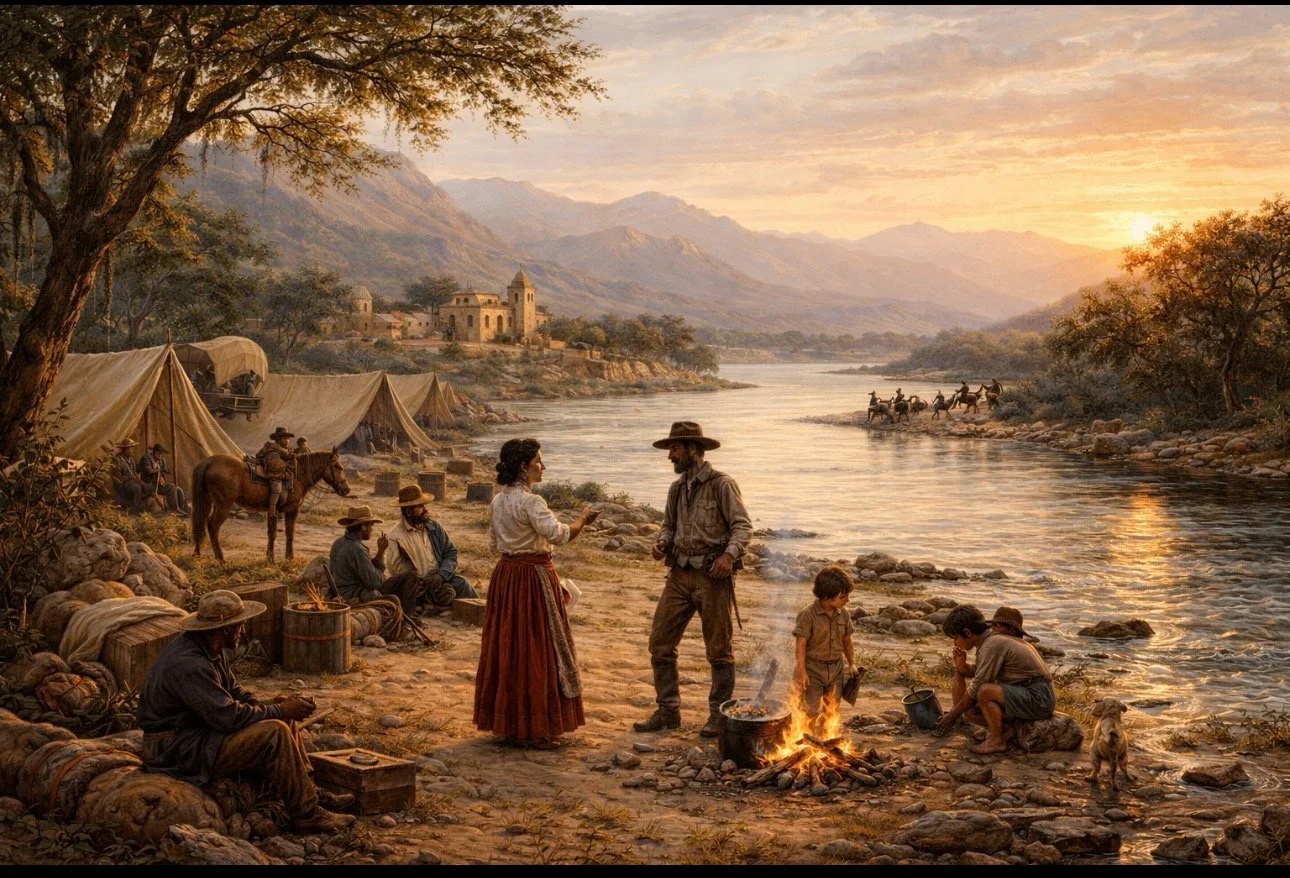
No projections required. If used, limit to one or two still images (river at night, a single tree).
---
ONE ACT
Scene: “A Voice Across the River”
[Lights rise softly. SILVIA enters slowly, sits in the rocking chair. She holds the folded emancipation bond in her lap. The lantern glows beside her.]
SILVIA (to the audience, quietly)
I was born into bondage.
I do not remember where.
(a long pause)
My people said Louisiana. Maybe Mississippi. Spanish territory, back then.
But memory… memory gets swallowed up when you’re taken too young to know.
[Cool light flickers. A memory: a young girl’s silhouette is pulled away from a woman’s reaching hands. SILVIA watches, still.]
Twelve years old. Sold twice.
First from my mother.
Then west.
West to a place they called Texas – though Texas wasn’t Texas yet. It was Mexico. And the borders moved like water.
[Sound of water – very low, constant.]
---
The man who bought me called himself Cryer.
I do not speak his name often.
He brought me to a land where slavery was not supposed to exist – but still did. Mexico had banned the importation of slaves. Then outlawed slavery entirely. But the slaveholders cried foul, and Mexico gave Texas an exception.
(dryly)
An exception for cruelty.
[She touches the paper in her lap.]
That’s when I met John.
[JOHN WEBBER steps into a soft, warm light. He stands still. Then, slowly, he extends his hand toward her – palm up, empty. He does not speak.]
A white man from Vermont. He came from a place where winters freeze the breath in your mouth. He had been a doctor, then a soldier in the War of 1812. By the time I met him, he was just a man who couldn’t look away.
(to John, softly)
He saw me. Not my skin. Not my labor. Me.
[John lowers his hand. He remains present, watching.]
---
On June 11, 1834, John filed my manumission papers – and our children’s.
(holds up the bond)
They still rest in Austin’s archives: proof that a Black woman walked free in Texas before Texas even took its first breath.
We married in secret. The church refused us.
So we went to a priest with a rebel heart – Father Muldoon. A marriage like ours… white man, Black woman… illegal in the eyes of men, but sacred in the eyes of God.
[John steps closer. He and SILVIA stand side by side, not touching, but aligned.]
---
We built our home on Wells Prairie. Planted crops. Raised oxen. Ran a ferry across the Colorado. They called it Webber’s Prairie. Later – Webberville.
[Pause. She looks at her hands.]
I remember the feel of the ferry rope. Rough. Worn. It would cut into your palms if you weren’t careful. I remember the smell of the river after a rain – mud and something green. I remember John coming up from the fields, sweat on his neck, and our youngest running to meet him.
(a small, private smile)
Those were the years I thought we might stay forever.
[Light shifts – cooler, uneasy.]
---
But the Revolution came. And with it, new laws.
After 1836, Texas became a Republic. They changed the rules. Said a Black woman couldn’t be freed without the legislature voting on it. Voting on me. Said a white man and a Black woman couldn’t be married at all – jail if you tried, worse if you succeeded.
(quietly)
We were already married. Already free. But the law didn’t care what we had built.
[Neighbors’ voices – distant, overlapping, hostile. Not actors – just sound design: murmurs, a stone hitting wood.]
Neighbors stopped visiting. Told their children not to play with ours. Some came by night with threats. Others tried to take our land through courts and cowardice.
[John steps forward, places himself between SILVIA and an imagined threat. He does not speak. He simply stands there.]
The government stayed silent. But its silence… was an answer.
---
[Sound of water rises slightly.]
By 1850, the Fugitive Slave Act was law. Slavery now hunted across borders.
But we – we had always been watching the river.
[She rises from the chair. Moves slowly, as if at a ferry rail.]
We heard whispers. Not of Canada – but of Mexico. South. Where slavery had been abolished for good. Our ferry became more than a crossing for wagons. It became a crossing for souls.
(lower)
Some nights, a knock would come. Late. Three raps, then a pause, then two more. John would go to the door. I would bank the fire. And a stranger would step inside – eyes wide, breath fast, clothes still wet from the river.
I never asked their names. Names could be hunted. But I asked where they needed to go. And we took them – under starlight, across the Colorado, toward the Rio Grande.
[Pause. She touches the bond again.]
They say Harriet Tubman guided people north. I never met her. But I believe we were kin in spirit. Just as she led them up into freedom – we led them down, into Spanish words that meant liberty.
We were called traitors. Harborers. Outlaws.
But we were never called liars.
---
[The lantern flickers. SILVIA sits back down, slower now, heavier.]
When the danger grew too great, we left.
We crossed the Rio Grande. Left behind the ferry, the home, the trees we planted – I remember the pecan tree by the kitchen door. I planted it as a sapling. I never saw it full grown.
[Sound of water – louder now, then receding.]
We weren’t alone. Other Black families crossed too – runaways, Unionists, lovers whose only crime was loving against the law.
---
[A new warmth in the light – not the same as before. This is Mexico light: softer, more patient.]
In Mexico, we were outsiders still. We did not speak the language well. The soil was different – drier, harder to plant. But we were safe.
[She looks at John. He nods once, almost imperceptibly.]
We built again. Not what we had lost – something new. A house with a dirt floor and a roof that leaked when it rained. But the door faced south, toward the sun. And no one came to take it from us.
John found work. I kept a garden. Our children grew up speaking Spanish better than English. And at night, when the stars came out over the Rio Grande, I would sit outside and listen.
(long pause)
I do not know if I ever truly stopped running.
[She lets that sit. A full five seconds of silence.]
But I know this:
We built something. A legacy. A family. A quiet kind of freedom that crossed rivers and outlasted chains.
[She rises. Holds the emancipation bond to her heart.]
---
[Light shifts to warm, direct – present tense. She steps forward, out of the memory space, speaking directly to the audience as if to one person.]
They tried to write us out. The records are full of blanks and silence and the wrong names. But you – dear descendant – you have written us back in.
(beat)
Now I have one more thing to tell you.
[She extends the bond slightly, then pulls it back.]
Don’t just remember us. Build something. Whatever river you face – cross it. And on the other side, don't wait for freedom to be given.
Build it.
[She sets the bond down on the chair. Turns. Exits slowly.]
[The lantern flickers once, then goes black.]
[Sound of water – one last breath – then silence.]
---
END OF PLAY
---
Summary of Applied Considerations
Consideration Implementation
Reduce historical lecture Removed recitation of dates and laws (1827, 1829, Vicente Guerrero). Kept only essential context (Mexico gave Texas an exception, Republic changed rules, Fugitive Slave Act) – now embedded in sensory, emotional language.
Add sensory moments Added: feel of ferry rope, smell of river after rain, sweat on John’s neck, pecan tree by kitchen door, soil difference in Mexico, roof that leaked.
John Webber’s silent gestures Added three specific actions: extending empty palm, stepping between Silvia and threat, nodding once in Mexico.
Expand crossing and building in Mexico Added new section: crossing details (three knocks, banked fire, wet clothes), Mexico light as distinct warmth, house with dirt floor, children speaking Spanish, sitting under stars.
Internal emotional arc Silvia moves from: survival telling → remembering joy (Webber’s Prairie) → loss and pressure → action (ferrying fugitives) → grief of leaving (pecan tree) → rebuilding in Mexico → final realization (“I do not know if I ever truly stopped running”) → direct charge to descendant. Clear shift from witness to testator.
Clarify voice / remove academic phrasing Changed “Manumissions now needed the legislature’s blessing” to “Said a Black woman couldn’t be freed without the legislature voting on it. Voting on me.” Changed “interracial marriage outlawed” to “a white man and a Black woman couldn’t be married at all – jail if you tried.”
Ensemble Cut under‑specified ensemble entirely. Replaced with: sound design (murmurs, stone, knock), lighting shifts, and John as sole silent figure. Production note below retains option for silhouettes.
Line‑level notes Kept “I do not speak his name often.” Revised John’s introduction. Kept “We were called traitors… never called liars.” Gave space to “I do not know if I ever truly stopped running.” Added final instruction: “Build it.”
---
Production Note (Optional Ensemble)
If a director wishes to restore the ensemble as silhouettes or pantomime figures, limit them to three repeating actions only:
· Cryer figure – stands with arms crossed, turns away when Silvia speaks his name.
· Fugitive figure – appears only during “Some nights, a knock would come” – crosses the stage silently, never looks back.
· Child figures – appear during Webber’s Prairie memory, playing, then disappear when neighbors’ voices begin.
Otherwise, the play works fully with a single actor, a lantern, and sound.
---
This revised version is ready for performance or for pasting alongside Outcasts of the Land as a companion piece. The two plays now share a consistent voice and complementary structures: one examines the archive’s failure, the other supplies the ancestor’s testimony.
ONE ACT
“A Voice Across the River”
PRODUCTION NOTE
Production & Staging Notes
-
Description text goes here
-
Description text goes here
-
Description text goes here
ARCHIVAL NOTE
Keep this consistent with your system:
This work is informed by descendant memory, archival records, and historical context. Where the record is silent, that silence is preserved.