

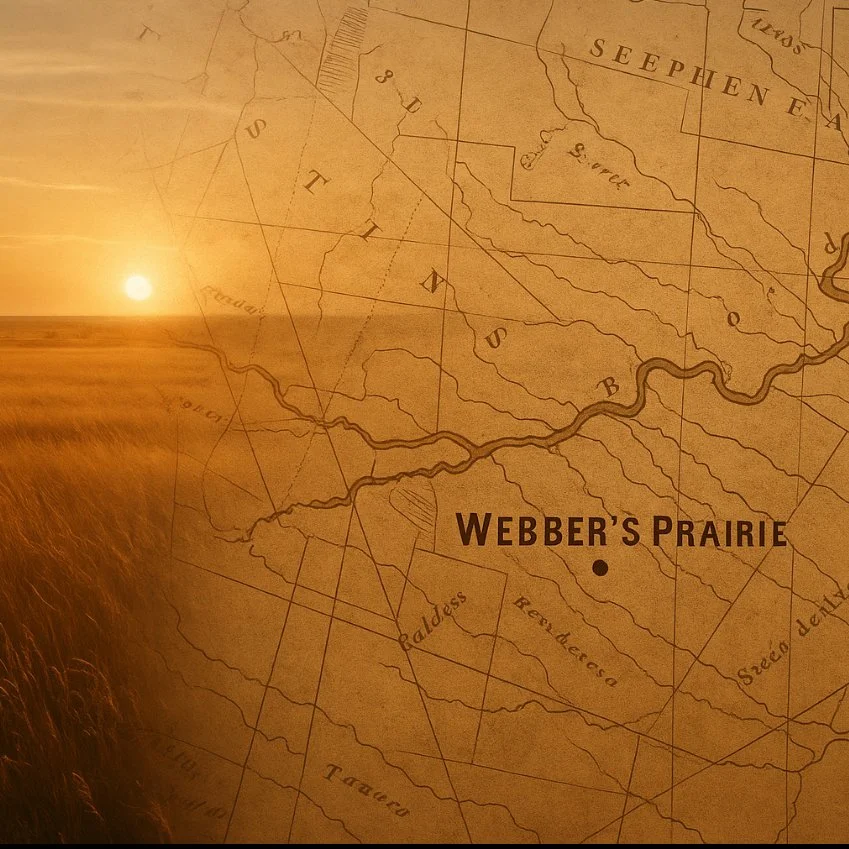
THE WEBBER RESEARCH LIBRARY
Sources, Documentation, and Methodology Supporting the Webber Historical Narratives
This page documents the research foundations, legal context, and archival framework supporting the published literary works.
ARCHIVAL POSITIONING
Curatorial Statement
This platform approaches John Ferdinand Webber as a complex historical figure whose life illuminates broader frontier dynamics and the evolving meanings of freedom in early Texas.
As both curator and descendant, I present this history through documented evidence, archival records, and structured narrative interpretation. The work examines legal decisions, migration patterns, and community formation within the contested landscape of the Texas borderlands.
Alongside him, the life of Silvia Hector Webber remains central to this archive. Her resilience, care, and moral courage shape how this history is understood and taught. Together, their story invites public reflection on family, law, and refuge across the Rio Grande—and how those choices continue to echo across generations.
— Historical Programs Director & Webber–Hector Descendant
Primary Research Navigation
This section organizes the primary research pathways used to construct and verify the Webber historical narrative.
-
Contents:
• Briscoe Center for American History
• Travis County Brand Books
• Hidalgo County Records
• War of 1812 Pension Files
• East Baton Rouge Probate Records
• Mexican legal documentation references
This becomes your institutional transparency section.
-
Contents:
• Mexican abolition law (1829)
• Republic of Texas legal changes (1836)
• Census racial classifications (1850–1910)
• Confederate statutes affecting interracial families
This supports interpretive work without duplicating it.
-
Explain:
How census entries were interpreted
Why racial descriptors shifted
How property valuations were analyzed
How land records establish continuity
This makes your project academically defensible.
-
This is important.
Include:
• How archival silence is handled
• How oral history is marked
• Where reconstruction begins
• How speculation is avoided
• Citation standards
This section elevates your entire site.
-
Keep this.
But tighten it.
Explain clearly:
• Class 041 — Educational services
• Online non-downloadable literary works
• Historical research presentation
• Documentary content
No marketing tone. Just legal clarity.
-
This section is excellent — keep it.
Explain:
• Digital archiving standards
• Version tracking
• Ongoing research updates
• Descendant contributions
This positions you as steward, not just author.
WHAT THIS LIBRARY CONTAINS
Deep narrative interpretation, legal context, and family archival reconstruction.
This library provides:
• Archival source repositories
• Census and legal documentation frameworks
• Methodology and narrative ethics
• USPTO Class 041 service alignment
• Digital preservation and archival architecture.
Full literary works are presented in “Historical Arts.” Primary documents are preserved in the “Archive.
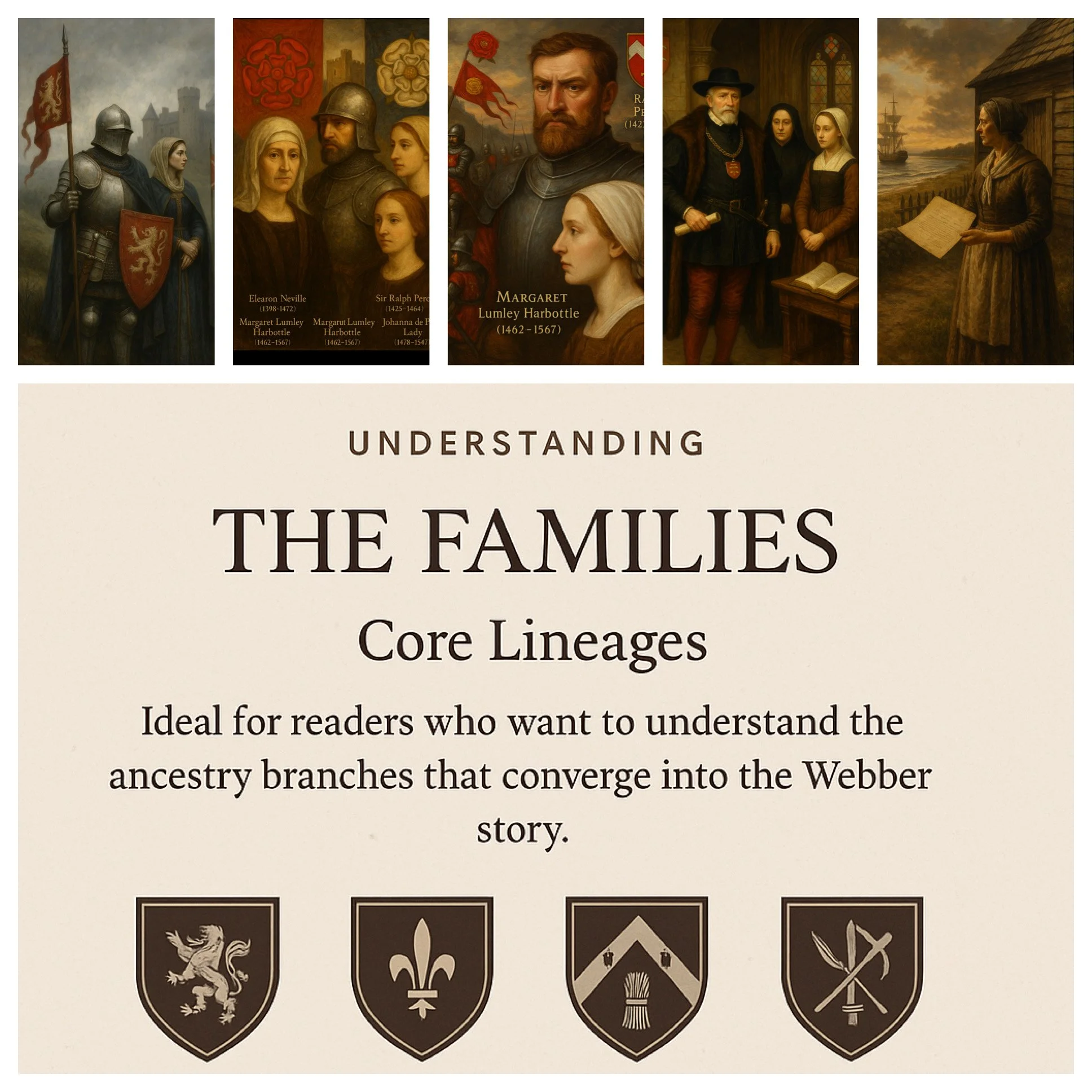
ARCHIVAL FRAMEWORK
A structured system organizing narrative, documentation, classification, and interpretive scholarship across the Webber digital archive.
-
a id="archive-overview-trilogy"></a>
## PRIMARY WORK: THE TRILOGY
### THE LINEAGE OF WIND AND STONE
A Braided Narrative of Conscience from English Castles to the Texas Frontier
**Total: 5,217 words*
---
### VOLUME I — The Soul (2,400 words)
- Prologue: Two Awakenings – Historical Thread & Personal Interlude
- I. The Stone Foundations (1325–1650) – The Walls of Belief / What Stone Teaches
- II. The Atlantic Crossing (1650–1795) – New World Covenants / The Weight of Water
- III. The Texas Crucible (1795–1865) – The Doctor's Calling / The Pulse of the Bond
### VOLUME II — The Law and the River (1,415 words)
- Prelude: The River as Witness – Personal Interlude
- I. Webber's Prairie (1827–1840) – The Unwritten Work
- II. The Ferry at Dusk (1840–1861) – The Lantern's Glow
- III. Exile and Rebuilding (1861–1880) – The Misspelled Name
### VOLUME III — The Inheritance of Light and Land (1,402 words)
- Prelude: The Afterlight – Historical Thread & Personal Interlude
- I. The Long Silence (1880–1965) – Scattered Stories
- II. The Reclamation (1966–2025) – The First Thread / The Archivist's Moment
- III. The Living Inheritance – The Pattern Revealed / The Digital Threshold / The Compass
- Epilogue: The Record Changes Hands
- Conclusion: The Pattern Holds
-
a id="archive-overview-trilogy"></a>
## COMPANION PIECE: BIOGRAPHY
### JOHN FERDINAND WEBBER: A MAN WHO STOOD HIS GROUND (1,376 words)
A Biography of Courage and Commitment
- Foreword: The Choice
- Chapter One: The Making of a Man
- Chapter Two: The Defining Choice
- Chapter Three: A Life of Daily Devotion
- Chapter Four: A Strategic Withdrawal
- Chapter Five: A Legacy Written in Ink and Land
- Chapter Six: The Next Generation
- Epilogue: The Ground He Stood On
-
a id="archive-overview-trilogy"></a>.
## INTELLECTUAL PROPERTY & CLASSIFICATION
### USPTO Classification Framework — Class 41 (Primary Class)
This digital archive is an educational service under USPTO Class 41.
Relevant Sub-Classifications:
- 41/1 — Historical & Genealogical Education Services
- 41/7 — Instruction by Displayed Image (digital narrative interfaces)
- 41/50 — Use of Particular Media (interactive exhibits)
- 41/69 — Records & Memorial Displays (document presentation)
Supporting Classes:
- 434/300 — Education & Demonstration: History
- 434/365 — Document Display Systems
- 705/1.1 — Genealogical Data Processing
- 715/200 — Multi-page Digital Presentation
### Methodology & Research Approach
This archive follows the principle of “marking silence rather than filling it.”
Where the record is silent, silence is acknowledged.
Where documentation exists, it forms the foundation.
-
## Methodology & Mission Statement
### I. Purpose of This Research Framework
The Webber Chronicle is built upon a combined foundation of archival investigation, descendant-led interpretation, and evidence-based historical analysis. Our methodology brings together primary documents, oral histories, legal statutes, and contextual scholarship to construct a clear and responsible narrative of the intertwined lives of John Ferdinand Webber and Silvia Hector Webber.
This framework supports our educational services under Class 41, ensuring that all content presented on this platform is accurate, accessible, and grounded in verifiable historical sources.
---
### II. Research Approach
1. Primary Source Documentation
We rely on verifiable archival materials, including:
- U.S. Census records (1850, 1870, 1880)
- Emancipation documents (1834 Silvia Hector Webber bond)
- Probate inventories (Flowers, 1816)
- Land grants, petitions, and legal filings
- Hidalgo County settlement records
- War of 1812 muster rolls
- Oral histories preserved by descendants and community elders
2. Contextual Legal & Social History
Because the Webber family lived at the shifting edges of multiple legal systems—Spanish, Mexican, Texian, and U.S.—this project interprets their experiences through the changing laws of slavery, manumission, immigration, marriage, and race.
3. Descendant-Centered Interpretation
This methodology acknowledges the truth that many historical narratives—especially those involving slavery, borderlands communities, and multiracial families—have been shaped by omission.
Descendant memory fills gaps left by official records, offering insight into:
- cultural survival
- community networks
- intergenerational storytelling
- acts of protection and resistance
We treat descendant accounts as living sources that, when paired with documentation, deepen our understanding of this history.
4. Transparency in Narrative Reconstruction
Where the archive is incomplete, we mark interpretive choices clearly. Narrative passages that synthesize evidence are distinguished from verified data points.
This ensures clarity for researchers, educators, and students.
---
### III. The Webber Chronicle — Mission Statement (Full Version)
The Webber Chronicle exists to preserve, interpret, and share the intertwined lives of John Ferdinand Webber and Silvia Hector Webber, a frontier family whose choices reshaped the meaning of freedom in early Texas. Through narrative history, archival reconstruction, and descendant-led storytelling, our mission is to illuminate how their love, defiance, and community-building shaped both sides of the Rio Grande.
We present this history with clarity, humility, and rigor—honoring the lived experiences of those who were enslaved, displaced, or written out of official memory. By bringing together documents, oral histories, timelines, and creative interpretation, we offer a learning space where the past becomes a guide for understanding race, law, and identity in America.
The Chronicle invites readers, researchers, and descendants to explore a story carried across three rivers—
from the Mississippi, to the Colorado, to the Rio Grande—
and into the living memory of a family still shaped by their courage.
Our mission is simple and enduring:
to remember fully, to teach honestly, and to preserve a legacy of resilience for generations to come.
---
### IV. Commitment to Accuracy & Accessibility
We commit to:
- citing all sources whenever possible
- ongoing review and correction of historical data
- open access to family materials where permissions allow
- making educational resources accessible to researchers, schools, and communities
- presenting multiracial borderlands history with integrity
---
### V. Ethical Considerations
Our methodology is guided by:
- respect for the lived experiences of enslaved and marginalized people
- acknowledgment of historical harm
- transparency in interpretation
- responsibility to descendants and communities represented here
This ethical foundation ensures that The Webber Chronicle remains both a scholarly resource and a place of remembrance.
---
### VI. How to Cite This Project
Educators, scholars, and students may cite this project as:
**The Webber Chronicle: Research Library & Digital Archive.
Curated by a descendant of the Webber family.
www.[yourdomain].com (accessed [date]).**
---
-
<a id="archive-overview-technical"></a>
## DIGITAL PLATFORM & TECHNICAL IMPLEMENTATION
### Platform Architecture
- CMS: Squarespace 7.1
- Document Handling: Integrated media galleries + archival scans
- Accessibility: WCAG 2.1 AA
- Responsive Design: Optimized for desktop, tablet, and mobile
### Interactive Features
- Progressive reading experience with section save-state
- Zoomable document viewer for archival records
- Interactive timeline with clickable markers
- Searchable ancestor index
- Secure descendant submission portal
---
## Preservation Strategy
- Regular backups to redundant secure storage
- Export options for academic archiving
- Print-on-demand formats for physical preservation
- Long-term partnership with historical repositories
---
## Continuing the Work
Future expansions include:
1. Extended document collections
2. Descendant oral histories
3. Partnerships with historical societies & universities
4. Educational curriculum development
5. Spanish translations for borderlands accessibility
---
Last Updated: 2025 — Archive Status: Active Research & Expansion
Future Research & Archival Questions
──────────────────────
These research questions identify areas where the historical record remains incomplete and where continued archival investigation may expand the documented narrative.
The John Ferdinand Webber Archive
The archival record of John Ferdinand Webber and Silvia Hector Webber remains in development. While foundational documents have been identified and verified, several areas require further historical investigation.
-
1. The Legal Mechanics of the 1834 Emancipation Bond
Archival records confirm that John Ferdinand Webber secured the emancipation of Silvia Hector Webber and their children through a formal bond filed in 1834. The precise legal and financial mechanics of this transaction remain incompletely reconstructed. Surviving documents indicate that collateral was pledged, yet the ultimate resolution of the bond—whether through property forfeiture, repayment, or negotiated settlement—requires further investigation through land records, court minutes, and related legal filings.
-
Silvia’s origins in Spanish West Florida remain incompletely documented. Existing records identify her presence within the Flowers estate inventory and subsequent sale records, but her familial relationships and early migration pathways require deeper investigation. Research priorities include:
• Parish and probate records in Louisiana
• Estate documentation associated with the Flowers family
• Cryer family records in Arkansas Territory
• Relevant Spanish colonial administrative archives
This line of inquiry is central to reconstructing her early life and familial network.
-
Cross-Border Freedom Networks
Regional scholarship documents the movement of enslaved people from Texas into Mexico during the mid-nineteenth century. Oral traditions and historical accounts associate the Webber ranch and ferry with this broader borderlands context. Additional research may clarify how the family’s ferry and ranch operated within regional migration patterns and whether documented cases of assistance can be identified in contemporary records.
-
The adult lives of the Webber children remain only partially documented. Their marriages, land ownership, racial classification in census records, and movements between Texas and Mexico provide opportunities for genealogical and social historical research into the experiences of mixed-race families in the nineteenth-century borderlands.
-
Civil War-Era Experiences in Hidalgo County
Historical accounts indicate that members of the Webber family held Unionist sympathies during the Civil War and at times sought temporary refuge across the Rio Grande in Mexico. The precise circumstances of these movements and the broader impact of the conflict on the family’s ranch and ferry operations remain only partially documented.
Further investigation of Confederate military records, regional correspondence, and Reconstruction-era voter rolls may help clarify the family’s activities, political affiliations, and experiences during this period of conflict and transition in the Rio Grande borderlands.
-
Evidence suggests that John Ferdinand Webber used the name “Juan Fernando” in certain Mexican records. Further examination of civil registers, land transactions in Tamaulipas, and regional municipal records may illuminate how the family navigated life within a transnational borderlands community.
⸻
-
Historical geographic and archaeological research may help locate and document the physical remains of the Webber ranch and ferry site along the Rio Grande. Land grant surveys, Hidalgo County deed records, and marks-and-brands registries may assist in reconstructing the material landscape of the family’s operations.
⸻
-
Comparative study of the Webbers alongside other mixed-race or Unionist families in the Rio Grande Valley may reveal broader patterns of resistance, adaptation, and community formation within the nineteenth-century borderlands.
⸻
-
Descendant communities preserve oral histories, family documents, and generational memory that can complement the archival record. Collaborative research efforts between historians and descendants offer important opportunities to expand the historical record while clearly distinguishing oral tradition from documentary evidence.
Key archival collections, repositories, and source systems informing the Webber historical record.
This archive supports interdisciplinary research across history, genealogy, legal studies, archaeology, and borderlands ethnography.
Ongoing work is strengthened through collaboration between academic researchers and descendant communities, ensuring that documentary evidence remains grounded in lived memory and regional knowledge
Archival Repositories & Sources
-
• Briscoe Center for American History — emancipation bond records
• Hidalgo County Clerk Records — land deeds and marks & brands
• Federal Census Schedules (1850–1880) — family structure and occupation
• Hidalgo County Historical Commission / UTRGV Collections — regional materials
• War of 1812 Pension Records — military service documentation
Then a final paragraph:
Interdisciplinary Research Framework
This research intersects with borderlands history, legal history, genealogy, archaeology, and descendant oral tradition.