

The Stories · Rio Grande
The Hidalgo Compound
A Community Architecture
"We were not scattered. We were planted."
IThe Architecture of Kinship
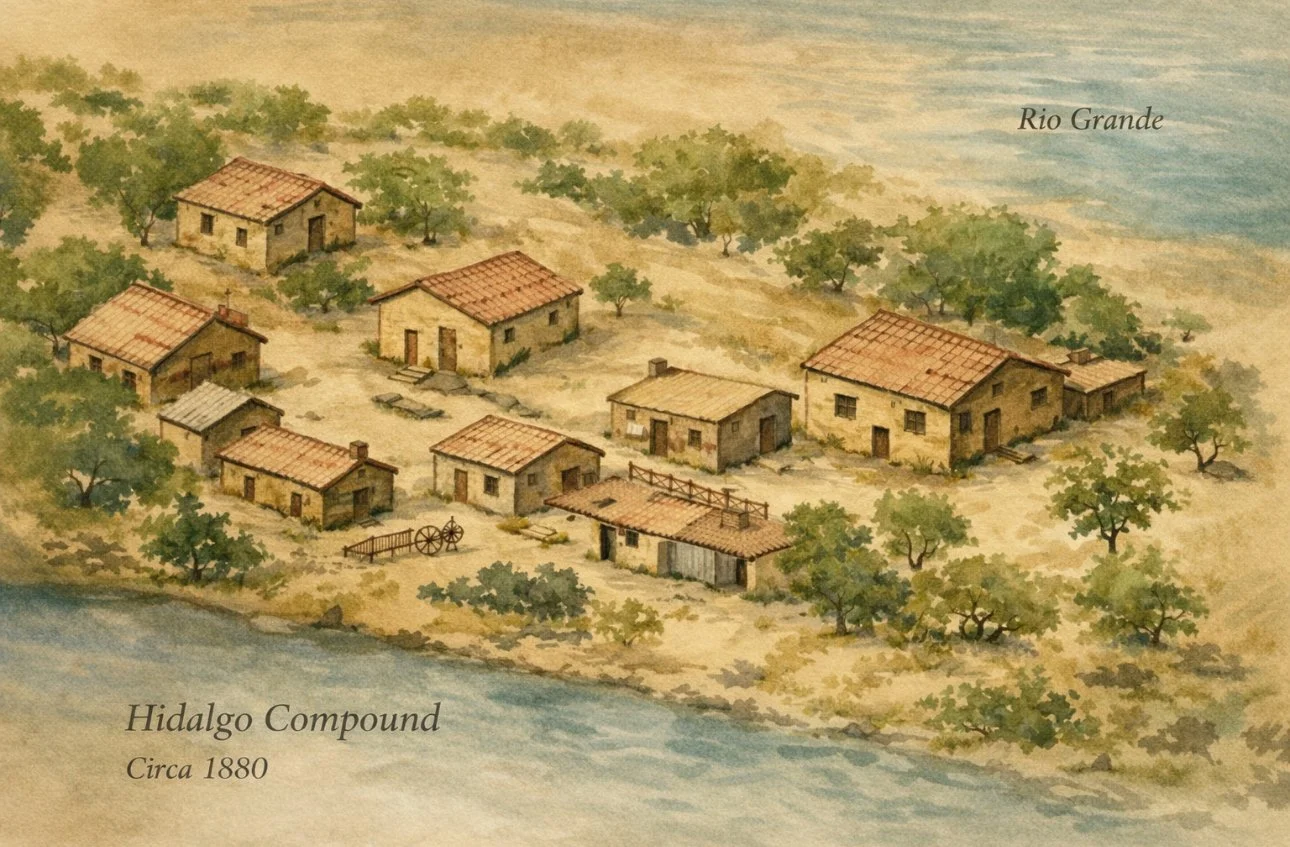
The 1880 Hidalgo County census reveals more than names — it shows a blueprint of survival. On the Texas borderlands, where families could easily be torn apart by violence, poverty, or law, the Webbers built something remarkable: a compound of kinship.
What appears as separate dwellings in official records was, in reality, a carefully arranged constellation of homes. John and Silvia Webber, now in their eighth decade, stood at the center of a living fortress they had spent fifty years building.
IIThe Compound — 1880
Dwelling 131 — The Heart: John & Silvia Webber
John F. Webber, 80 — Farmer
Silvia Webber, 70 — Wife
Elsie Jackson, 46 — Daughter (Widowed)
John Jackson, 18 — Grandson
William Jackson, 16 — Grandson
James Webber, 38 — Son
Dwelling 125 — The Next Generation: The Biddy Family
Jasper G. Biddy, 38 — Farmer
Sarah Jane "Juanita" Biddy, 28 — Daughter
John A. Biddy, 8 — Grandson
Virginia Biddy, 6 — Granddaughter
Silvia Biddy, 4 — Granddaughter
Mary Biddy, 2 — Granddaughter
Dwelling 125 (Adjacent) — The Anchor: Sabrina Singleterry
Sabrina Singleterry, 32 — Daughter
Keeping house within sight of her mother's door.
IIIA Deliberate Design
This was no accidental clustering. The compound represented a strategic response to generations of threat.
Economic Security — Multiple farming households sharing resources, labor, and protection against crop failure or economic hardship.
Child Protection — Grandchildren grew up surrounded by aunts, uncles, and cousins — a human shield against the world that wanted to break them.
Cultural Preservation — In this tight-knit community, stories could be told, traditions maintained, and resistance remembered without outside interference.
Elder Care — John and Silvia, the family patriarch and matriarch, remained surrounded by children and grandchildren who honored their legacy.
IVThe Borderlands Context
The compound stood as a direct challenge to the racial and social order of post-Reconstruction Texas. While Black and mixed-race families across Texas were being systematically broken by economic pressure and violence, the Webbers chose concentration. In a region where mixed-race families often faced social isolation, they created their own complete social world. By maintaining their complex family structure across multiple households, they made themselves impossible to ignore or forget.
VProximity Was Protection
Each dwelling stood within sight of the others — close enough to hear a call for help, to share a meal, to watch over children playing between homes. Age was honor: John and Silvia at the center, their wisdom and experience valued rather than discarded. Kinship was kingdom: the Webbers, Jacksons, Biddys, and Singleterrys demonstrated that family could be both sanctuary and fortress.
VIThe Walls We Build
The true architecture of the Hidalgo compound wasn't in its physical structures, but in its relationships. While other Texans built fences to keep people out, the Webbers built connections to keep their people in.
This cluster of dwellings represented the ultimate expression of John and Silvia's life work: the creation of a space where their descendants could live freely, love openly, and remember completely.
The land in Hidalgo County has been plowed and planted many times since 1880. But the imprint of that compound remains — not in wood or stone, but in the unbroken line of memory that connects us still to those dwellings, and to the extraordinary family that called them home.
Postscript — Today, descendants of the Webber compound still live within fifty miles of that original settlement. The architecture of kinship they built continues to shelter generations. Family cluster drawn from the 1880 Hidalgo County federal census.