

The Intimate Gallery
Family & Community
Three stories, presented as a curated gallery:
a documentary census narrative, a descendant-narrated novelette, and a spatial study of sanctuary on the Rio Grande.
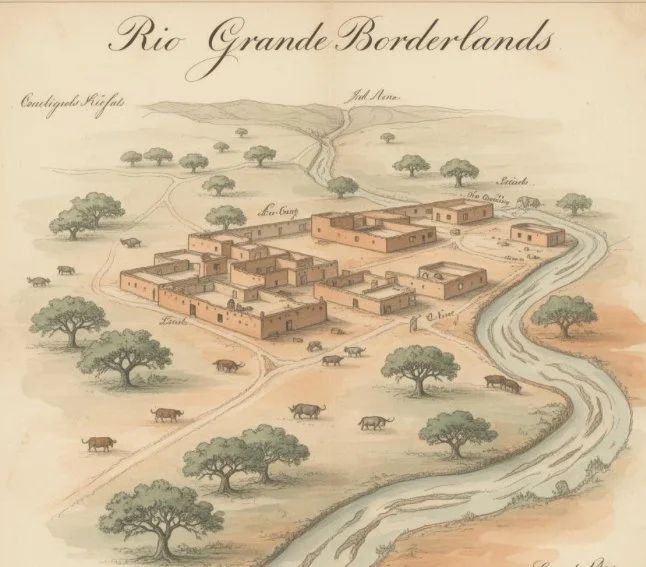
A spatial reading of the 1880 family cluster—how proximity became protection, and kinship became an architecture of sanctuary
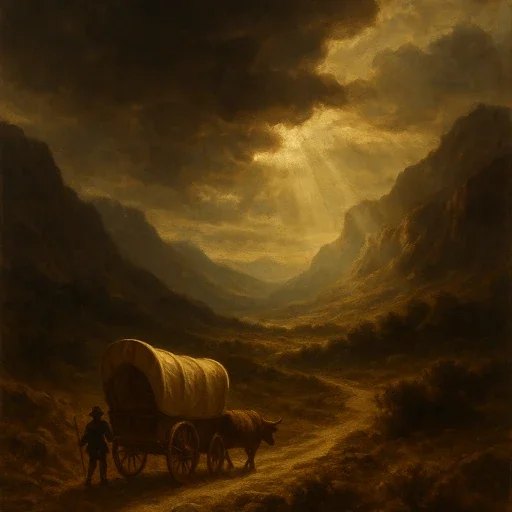
A historical novelette in the voice of a descendant reading Noah Smithwick—restoring names, dignity, and memory to a family written into the margins.
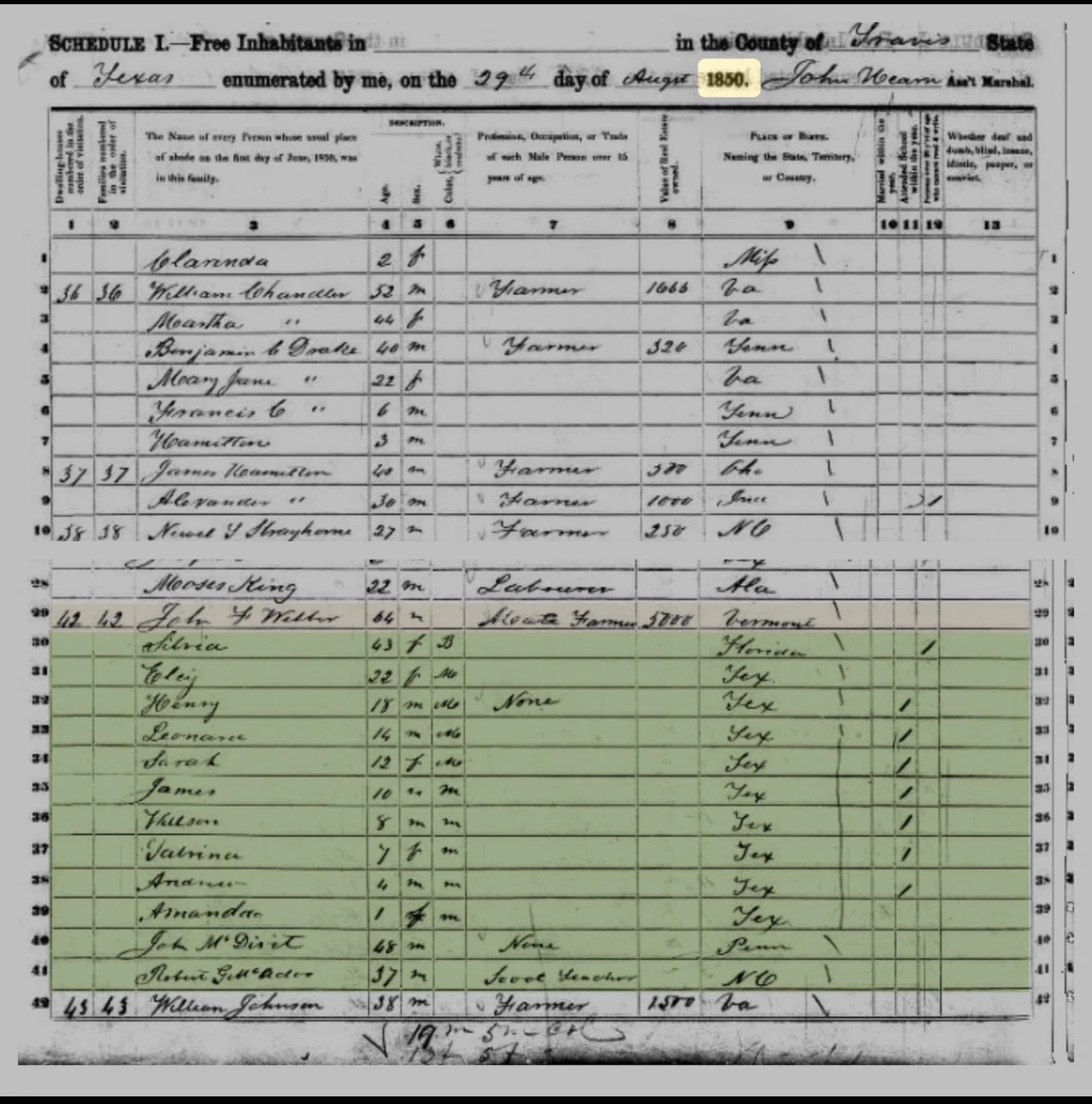
A descendant’s narrative anchored in the 1850, 1870, and 1880 census records—showing continuity, rebuilding, and recognition across generations.
-
A Family Rooted in Freedom and Community
A Descendant’s Narrative Inspired by the U.S. Census Records of 1850, 1870, and 1880
“The land remembers what was built upon it.”
— Webber Family Oral RecordThe Nucleus — 1850: An Act of Defiance
The 1850 census for Travis County contains a quiet act of rebellion.
On a page otherwise shaped by the assumptions of a slaveholding society, the enumerator recorded a household that refused to disappear. The head was John F. Webber, a white man born in Vermont. His wife was Silvia Hector Webber, a woman of color born in Spanish West Florida. Beneath their names appeared their children.
Next to each child, the census taker wrote the same, legally dangerous word: Mulatto.
In a state where interracial marriage was criminalized and free Black families lived under constant threat, this single page did not disguise their relationship. It did not obscure their children. It named them.
Together, John and Silvia built more than a household. They formed the nucleus of a community—one rooted in kinship, mutual care, and a shared refusal to vanish.
This record was not neutral.
It was quietly radical.The Bridge — 1870: Resilience and Rebirth
Twenty years later, the family appears again—this time along the Rio Grande.
The 1870 census does not read like a roster. It reads like a return. After years of war, hostility, and exile, John and Silvia are recorded in Hidalgo County, surrounded by children and grandchildren who had gathered close again.
Some had formed households of their own. Others remained within sight of the family center. What matters is not who is missing, but what remains unmistakable: continuity.
They were still together.
They were still visible.
They were rebuilding in a place where identity and community moved more fluidly than in Central Texas.The borderlands offered something rare—space to live openly, to recover, and to remain intact.
They did not disappear.
They regrouped.The Compound — 1880: An Architecture of Sanctuary
By 1880, the census no longer records a single household. It reveals a cluster.
At its center stand John F. Webber, eighty years old, and Silvia Webber, seventy. For the first time in federal records, the relationship column names her plainly:
Wife.
One word.
A lifetime in the making.Surrounding them are children and grandchildren living in close proximity across multiple dwellings. This was not accidental settlement. It was deliberate design—a multigenerational network built for shared labor, protection, and continuity.
In an era when Black and mixed-race families were routinely fractured by law, labor, and violence, the Webbers chose closeness. Proximity became defense. Kinship became infrastructure.
The 1850 household was the seed.
The 1880 compound was the tree in full growth.A Living Legacy
Read together, these moments trace more than demographic change. They reveal a philosophy of survival.
Across three decades, the Webbers demonstrate what they valued:
Continuity over dispersal
Elders at the center, not the margins
Children raised within a web of kin and memory
Spanish names appear beside English ones, signaling adaptation rather than loss. Identity here was not fixed; it was practiced.
Family memory confirms what the documents suggest. Stories passed not only through paper, but through proximity—through grandchildren raised within sight of those who remembered bondage, freedom, exile, and return.
Closing Reflection
Taken together, these moments tell a story not of fracture, but of endurance.
The violence that pushed the Webbers from Central Texas was meant to scatter them. Instead, it forced a refinement of vision. Along the Rio Grande, they built a fortress of kinship—transforming freedom from a legal condition into a lived structure of care.
The land remembers what they built.
Their descendants are its living memory. -
A Historical Novelette Inspired by the Life of John Ferdinand Webber and Silvia Hector Webber
🔒 Author’s Note
When I first opened Noah Smithwick’s The Evolution of a State—120 years after it was published—I did not expect to find my own family inside its yellowing pages.
I had grown up hearing fragments about John Ferdinand Webber and Silvia Hector Webber. A Vermont doctor who loved a woman the law said he should not. A free woman of color who carried herself with quiet defiance. A family who ferried travelers across rivers and, in whispered stories, may have ferried others toward freedom.
But in school, their names were not there. In the museums, their faces were absent.
And then, one day, I found them—in the words of a white neighbor who could not quite decide whether to admire or condemn them.
Smithwick’s memoir was written in 1899, nearly half a century after he last saw my ancestors. His words carry the prejudices of his time. He called my great-great-great-grandmother by a nickname that was not her own. He spoke of my great-great-great-grandfather’s marriage as a “low amour.” He tried, and failed, to fit their love into the categories he knew.
Yet in his fumbling honesty, Smithwick preserved a truth no official record had bothered to keep: that John and Silvia lived openly as family, endured persecution, and finally crossed into Mexico to keep their children free.
This novelette is my attempt to braid his account with our family’s memory. It is told in the voice of a descendant, reading Smithwick for the first time, and hearing in it the echoes of a legacy that refused to die.
Chapter One — The Name in the Margins
When I turned the page and saw it—Webber—my breath caught.
There it was, set down by a man who claimed to know them:
“Webber took his family home and acknowledged them before the world. There were others I wot of that were not so brave.” — Noah Smithwick
He did not call Silvia by her true name. He called her “Puss,” as if she were a servant, a pet, a curiosity. But I knew who she was. Silvia Hector. My ancestor. My great-great-great-grandmother.
Reading Smithwick, I realized I was not the first to remember them. But perhaps I could be the first to tell their story differently.
Chapter Two — Entangled in Love
Smithwick wrote that Webber had become “entangled in a low amour.”
Entangled. Low. Amour.
The words dripped with judgment. But I knew what they meant. They meant that John Ferdinand Webber—a physician from Vermont, a man who might have lived an easier life had he chosen differently—fell in love with Silvia Hector.
A woman born enslaved, who carried in her body the brutal arithmetic of law: children counted as property unless someone risked everything to change their fate.
Smithwick’s account tells us what John did next. He bought Silvia’s freedom, and that of their child, paying a sharp price to an owner “cognizant of the situation, [who] took advantage of it to drive a sharp bargain.”
That moment—unwritten in official records, carried only in Smithwick’s passing lines—was the hinge of our family’s history. Without it, there would have been no Webber descendants free to claim their names.
John built a fortified home—a log outpost on unsettled land—and brought his family there, declaring them as his own.
“He built a home and acknowledged them before the world…”
In a time and place where secrecy was safety, he chose love—and truth.
Chapter Three — Between Two Worlds
Smithwick admitted it plainly: the Webbers did not belong anywhere.
Not among the white settlers, who shunned them. Not among the enslaved, who resented their precarious freedom.
Silvia was received in kitchens but never at tables. She was called on when others were sick, when bread was needed, when neighbors were hungry. And she gave, without money, without price.
“There wasn’t a white woman in the vicinity but knew and liked Puss… if there was need of help, Puss was ever ready to render assistance.” — Noah Smithwick
Reading that line, I felt pride and rage mingling together. Pride, because her kindness had been so undeniable it pierced the armor of prejudice. Rage, because even as he admired her, Smithwick stripped her of her name.
But I whisper it back into the text now: Silvia.
Chapter Four — Seeds of Envy
The Webbers prospered despite exclusion. They built a ferry across the Colorado River. They tended fields. They raised children who were neither ashamed nor hidden.
And for this, the neighbors grew envious.
Smithwick recalled how John hired an Englishman to tutor the children. It was a simple act—education for his sons and daughters—but the community would not have it. They muttered about the influence on “slave negroes.” They threatened to mob the tutor.
“The cruel injustice of the thing angered me… I abhorred the situation, but I honored the man for standing by his children—whatever their complexion.” — Noah Smithwick
It was not only race that spurred them. It was the audacity of the Webbers’ independence. They were a family that bowed to no one—not even to the unwritten codes of Texas.
Chapter Five — The Last Meeting
That summer, John met again with Noah Smithwick beneath the shade of a low mesquite tree.
The two men sat apart but familiar. Old friends, now separated by the chasm of public opinion and personal risk.
“There’s freedom in Mexico. No one cares about color there. No man will call your children what they call them here.” — Smithwick
John was silent a long moment. The truth of it sat between them, heavy and clear.
“I’ve been thinking the same,” John finally said. “Not just for me. For them.”
Reading that dialogue more than a century later, I could almost hear their voices. One man warning. Another deciding. Two neighbors, divided by law, bound by memory.
It was the moment exile became inevitable.
Chapter Six — Across the River
Smithwick’s account ends abruptly:
“He took my advice, and I never afterward saw or heard of him.”
That is where the memoir closes the door.
But family memory keeps it open.
We know that Silvia and John crossed the Rio Grande with their children. That they planted again on land in Tamaulipas. That they lived not as fugitives but as themselves—at last.
Mexico, with its shifting politics and dangers, was not paradise. But it was a place where their children could grow without being branded as outcasts.
They were no longer hiding. They were building—again.
Chapter Seven — What Remains
When Smithwick’s daughter published his memoir in 1899, she likely did not know what it meant to descendants like me.
She thought she was preserving her father’s frontier tales. She did not know she was also preserving my family’s survival.
Reading it today, 120 years later, I understand the gift and the failure.
The gift is that their names survived at all.
The failure is that their dignity was dimmed by prejudice.
This novelette is my attempt to restore the balance.
To give Silvia her name back.
To give John more than the label of “low amour.”
To give their children a place in history that is not in the margins.
They were outcasts of the land.
But they were never outcasts of love.
And it is love that carried their story across rivers, across centuries, into my hands—and now into yours.
-
The Hidalgo Compound
Introduction
The census does not call it a compound. It never does.
It lists households, occupations, ages, and relations, each line meant to stand alone.
But when the entries are read together—1870, then 1880—something else takes shape: a lived architecture of kinship, work, and care.
The Hidalgo Compound was not a single structure. It was a community design—rooms arranged by need, not by title; dwellings clustered by trust; labor and shelter braided together along the Rio Grande.
This is not a story of walls and roofs alone.
It is a story of how people placed themselves near one another to remain free.
What follows reads census proximity as spatial intention—an interpretive method used throughout this archive.
1870: A Household on the Edge of the Rio Grande
In 1870, the census captures the first visible outline of the Hidalgo household.
Names appear that will later multiply. Ages suggest parents and grown children living within reach. Occupations reveal shared labor rather than individual advancement.
The river is close. So is memory.
What the census records as a “household” already functions as a node—one dwelling with gravity. People move in and out. Work overlaps. Children are not sent away. Elders are not isolated.
This reads as the seed of the compound.
Primary sources:
1870 U.S. Census, Hidalgo County
Borderlands land-use records
1880: Mapping the Compound
By 1880, the pattern is unmistakable.
Multiple dwellings appear in proximity—separate census entries, shared surnames, overlapping labor. What might look like dispersion on paper reads, on the ground, as intentional clustering.
The compound expands sideways, not upward.
Rooms are added when children marry.
Outbuildings appear where work requires them.
Distance is measured in steps, not property lines.
This is architecture as relationship.
Rooms, Roles, and Daily Rhythms
The Hidalgo Compound moved with the sun.
Cooking spaces were communal. Food traveled easily between kitchens.
Sleeping rooms reflected age and care—children near mothers, elders within earshot.
Women anchored interior rhythms—food, healing, teaching.
Men’s labor stretched outward—to fields, ferry work, and river crossings—but returned daily.
No one lived unseen.
Privacy existed, but isolation did not.
Work, Land, and the Borderlands Economy
The compound functioned as an economic organism.
Fields were worked collectively.
Labor shifted seasonally.
River knowledge—when to cross, when to wait—was shared.
The census lists occupations.
The compound reveals coordination.
This was borderlands expertise practiced daily.
Kinship, Neighbors, and Sanctuary
Kinship extended beyond blood.
Neighbors appear in the census with no shared surname but shared proximity. Compadrazgo—godparenthood, obligation, mutual care—filled the spaces the law refused to recognize.
People stayed when they needed shelter.
They moved on when it was safe.
No ledger records these movements.
The compound appears to have absorbed them quietly.
Architecture of Memory and Legacy
Nothing remains of the Hidalgo Compound that a surveyor would recognize.
But the architecture survives in pattern.
It lives in census clustering.
In oral memory.
In the way descendants still gather close—physically, emotionally, deliberately.
The Hidalgo Compound was never meant to endure as a monument.
It was meant to function.
And it did.
This was not just a place to live.
It was a way of arranging life so that freedom could hold.
-
---
<a id="river-ledger-prologue"></a>
### Prologue — The River That Remembers
The Rio Grande at dawn moves like a living archive—slow, deliberate, carrying memory in its current.
Mist lifts from the surface like breath, wrapping the mesquite in ghostlight.
It brings the scent of iron and salt, the smell of passage.
For centuries, the river divided nations.
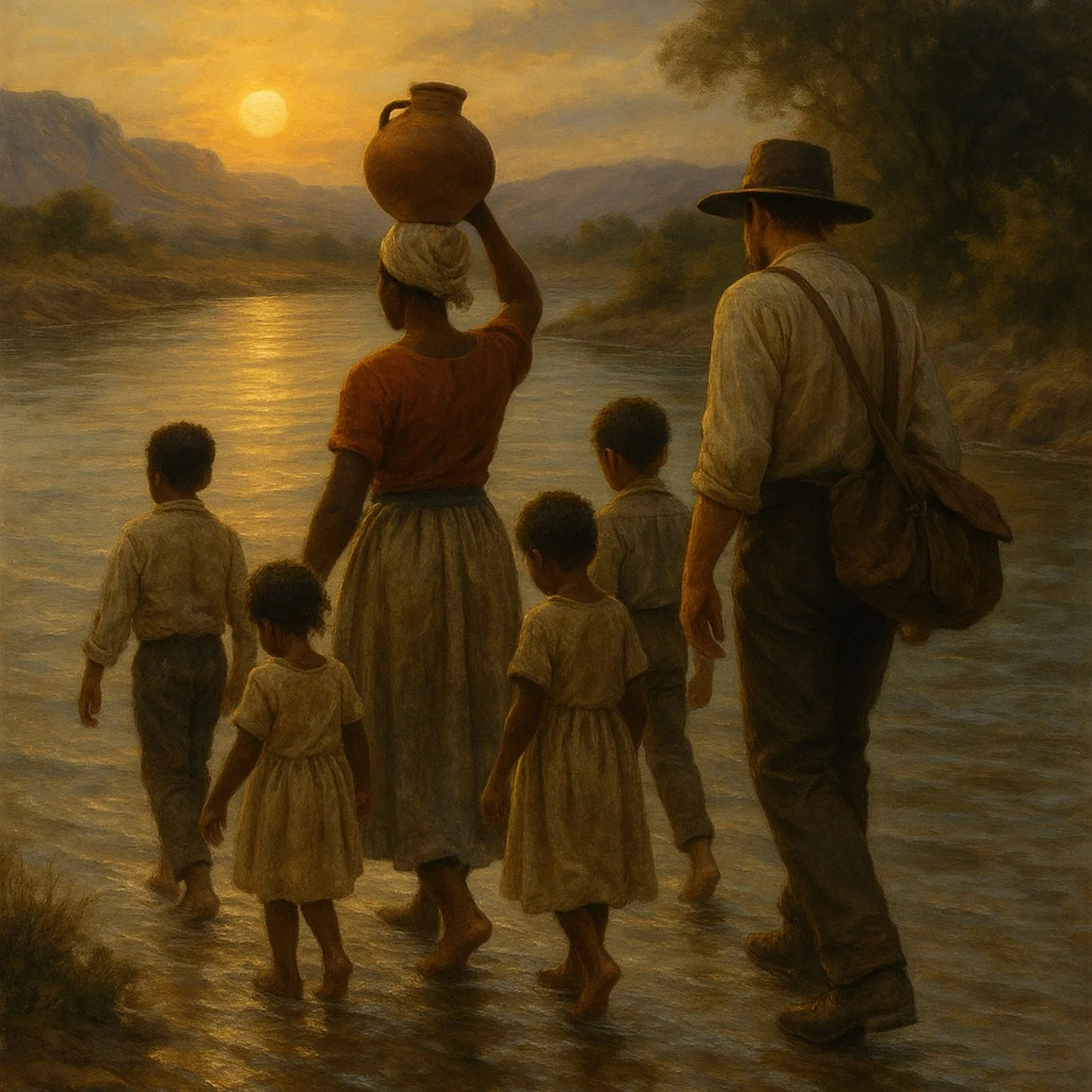
For the Webbers, it became a bridge—a covenant written in water.
In 1865, when John Ferdinand Webber and Silvia Hector Webber stood on its northern bank, they were not running.
They were carrying forward what they had always believed: freedom must be lived, not granted.
Behind them, Texas burned with the fever of war.
Ahead, Mexico shimmered in the heat—a fragile promise of mercy.
The river remembers every name, even the ones the records forgot.
---
### Act I — The Ledger of the Living and the Dead
Every courthouse carries the same faint scent—dust, ink, and the slow aging of paper.
Somewhere inside those walls lies a page that names the Webbers.
It is dated 1838:
License granted to John F. Webber to operate a ferry across the Colorado River, Bastrop County.
Nothing in that single line hints at what the ferry carried—or what that river would come to mean.
In the archive, the 1838 ferry license stands out—its edges worn, its ink unwavering.
A man’s future distilled into one quiet sentence.
That same period placed the household into the census record:
John Webber, physician; Silvia Webber, woman of color; children unnamed.
There is no mention of travelers who arrived after dark.
No record of whispered signals, folded blankets, or journeys that could not be spoken aloud.
Official ink records what is visible.
Conscience preserves what is not.
By the 1840s, Webber’s Prairie had become a patchwork of cabins and clearings.
Cotton grew. Ferries crossed. Whispers spread.
Silvia’s existence—free, Black, and unbowed—unsettled a town built on bondage.
Neighbors were polite in daylight and cruel in rumor.
A man named Elias Croft marked their land “under protest” in the assessor’s book.
When a preacher denied her communion, Silvia prayed by the river instead—her prayers shaped by a rhythm older than Texas, born on Louisiana riverbanks and carried west through the Carolinas.
The current became her congregation.
“Because the law forgets faster than love,” she told her daughters when they asked why she remembered everyone’s name.
Elsewhere in the courthouse, in a different ledger, appears another entry:
a brand registered to John F. Webber and Eliza.
Eliza was John and Silvia’s eldest daughter.
For a father to formally co-own a cattle brand with his daughter in nineteenth-century Texas was an act of deliberate foresight. A brand meant ownership, independence, and permanence. By placing her name beside his, John was asserting her right to transact, to hold property, and to secure a future in a world that rarely protected women—especially women of color.
This single entry transforms a bureaucratic line into a legacy.
It reveals belief made visible. Love rendered legible.
---
### Act II — Exile to Mexico
They left at dusk in 1862.
Silvia drove the wagon.
John walked beside her.
In her lap lay the emancipation paper she had carried for thirty years.
When they reached the Rio Grande, she pressed it to her chest as the current moved beneath them.
“We are not leaving,” she whispered.
“We are crossing.”
Hidalgo was clay roofs and wind-bent palms.
John healed without allegiance.
Silvia became La Doctora Morena—the dark woman who healed and remembered.
No census recorded them there.
Silence became its own archive.
---
### Act III — Return, Census, and Recognition
They returned north when the war quieted, but memory did not.
The ferry ran again.
The land bore scars.
The ledger reopened.
The 1850 census for Travis County is an anchor document—a single frame in a much longer story.
It records John F. Webber, 64, born in Vermont, and Silvia Hector Webber, 43, born in Spanish West Florida.
Listed with them are eight children at home: Eliza, Henry, Leonard, Sarah, James, Wilson, Sabrina, and Amanda.
Family memory holds a fuller record.
The census is a snapshot, not the whole portrait.
Next to each child’s name appears the same legally dangerous word: Mulatto.
In a state where interracial families were criminalized, the page is not neutral.
It is a quiet declaration.
By 1870, the family appears rebuilt in Hidalgo County.
By 1880, the census records what earlier ledgers refused to name:
John F. Webber, 80.
Silvia Webber, 70.
Relationship: Wife.
One word.
A lifetime in the making.
To see them there—side by side, finally named—was like watching a puzzle piece click into place after 140 years.
The record finally matched the truth they had always lived.
The 1850 household was the seed.
The 1880 compound was the mature tree.
---
### Epilogue — The Keeper of Names
When light fades over the river at dusk, I see her there.
One hand on the ferry rope.
One hand shielding the lamp.
Every name I write brings her closer.
Every record reopened breaks a silence.
The ferry was never just a ferry.
It was faith with a handle—
mercy that crossed water and came back again.
The river still runs—an archive under the moon.
The ledger, once closed, opens beneath our hands.
And in its reflection, her light continues to burn.
Why These Stories Live Together
These three narratives—census-based reconstruction, descendant novelette,
and architectural mapping—belong side by side. Together they reveal how the
Webber, Hector, Jackson, Biddy, and Singleterry families turned exile into
community and memory into strength.
As a curator and descendant, I invite you to read them not as separate tales,
but as one intertwined legacy of family, land, and resistance.
— Curator & Webber–Hector Descendant