

We Did Not Cross for Freedom — We Built It
A One-Act Monologue in the Voice of Silvia Hector Webber
Silvia — A dignified woman of African descent, age 60–80. Speaks with calm strength and deep emotional clarity. She carries a folded document — the 1834 emancipation bond.
John Webber — Appears only in memory sequences. Silent, but performs simple, repeated gestures.
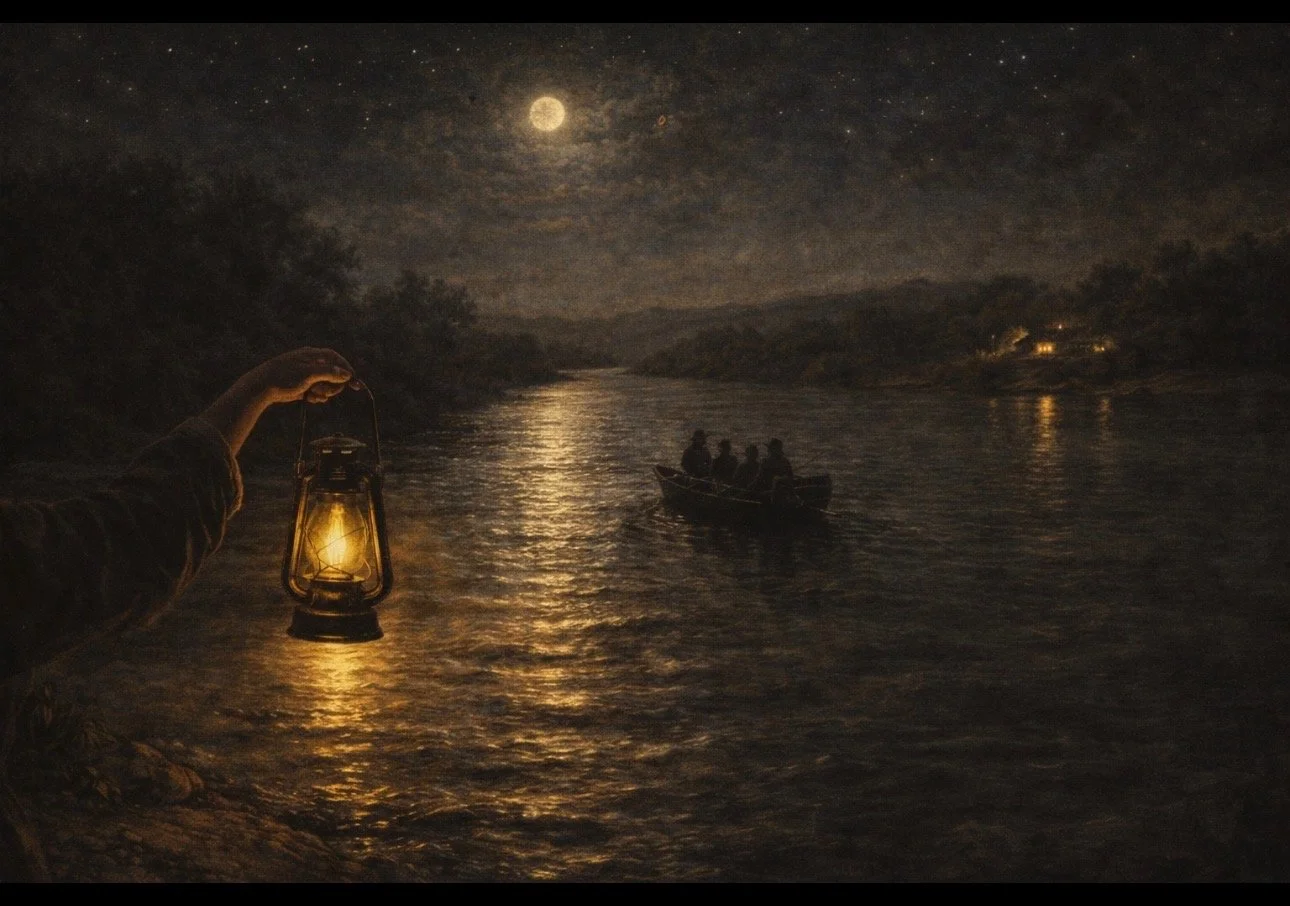
A bare stage. A single rocking chair. A lantern glowing beside it. Lighting shifts between present (warm, lantern lit) and memory (cooler, shadowed). Sound: water, constant but very low, rising only at key moments.
Scene: “A Voice Across the River”
One Act
[Lights rise softly. SILVIA enters slowly, sits in the rocking chair. She holds the folded emancipation bond in her lap. The lantern glows beside her.]
Silvia — to the audience, quietly
I was born into bondage.
I do not remember where.
(a long pause)
My people said Florida. Maybe Louisiana. Spanish territory, back then.
But memory… memory gets swallowed up when you’re taken too young to know.
[Cool light flickers. A memory: a young girl’s silhouette is pulled away from a woman’s reaching hands. SILVIA watches, still.]
Nine years old when they wrote my name in a dead man’s ledger.
Twelve when they sold me west.
West to a place they called Texas — though Texas wasn’t Texas yet. It was Mexico. And the borders moved like water.
[Sound of water — very low, constant.]
The man who bought me called himself Cryer.
I do not speak his name often.
He brought me to a land where slavery was not supposed to exist — but still did. Mexico had banned the importation of slaves. Then outlawed slavery entirely. But the slaveholders cried foul, and Mexico gave Texas an exception.
(dryly)
An exception for cruelty.
[She touches the paper in her lap.]
That’s when I met John.
[JOHN WEBBER steps into a soft, warm light. He stands still. Then, slowly, he extends his hand toward her — palm up, empty. He does not speak.]
A white man from Vermont. He came from a place where winters freeze the breath in your mouth. He had been a soldier in the War of 1812 — a private in the 31st Infantry — and he carried a healer’s hands, learned on battlefields, no diploma to his name. By the time I met him, he was just a man who couldn’t look away.
(to John, softly)
He saw me. Not my skin. Not my labor. Me.
[John lowers his hand. He remains present, watching.]
On June 11, 1834, John filed my manumission papers — and our children’s.
(holds up the bond)
They still rest in Austin’s archives: proof that a Black woman walked free in Texas before Texas even took its first breath.
We married in secret. The church refused us.
So we went to a priest with a rebel heart — Father Muldoon. A marriage like ours… white man, Black woman… illegal in the eyes of men, but sacred in the eyes of God.
[John steps closer. He and SILVIA stand side by side, not touching, but aligned.]
We built our home on Webber’s Prairie. Planted crops. Raised oxen. Ran a ferry across the Colorado. They called it Webber’s Prairie. Later — Webberville.
[Pause. She looks at her hands.]
I remember the feel of the ferry rope. Rough. Worn. It would cut into your palms if you weren’t careful. I remember the smell of the river after a rain — mud and something green. I remember John coming up from the fields, sweat on his neck, and our youngest running to meet him.
(a small, private smile)
Those were the years I thought we might stay forever.
[Light shifts — cooler, uneasy.]
But the Revolution came. And with it, new laws.
After 1836, Texas became a Republic. They changed the rules. Said a Black woman couldn’t be freed without the legislature voting on it. Voting on me. Said a white man and a Black woman couldn’t be married at all — jail if you tried, worse if you succeeded.
(quietly)
We were already married. Already free. But the law didn’t care what we had built.
[Neighbors’ voices — distant, overlapping, hostile. Not actors — just sound design: murmurs, a stone hitting wood.]
Neighbors stopped visiting. Told their children not to play with ours. Some came by night with threats. Others tried to take our land through courts and cowardice.
[John steps forward, places himself between SILVIA and an imagined threat. He does not speak. He simply stands there.]
The government stayed silent. But its silence… was an answer.
[Sound of water rises slightly.]
By 1850, the Fugitive Slave Act was law. Slavery now hunted across borders.
But we — we had always been watching the river.
[She rises from the chair. Moves slowly, as if at a ferry rail.]
We heard whispers. Not of Canada — but of Mexico. South. Where slavery had been abolished for good. Our ferry became more than a crossing for wagons. It became a crossing for souls.
(lower)
Some nights, a knock would come. Late. Three raps, then a pause, then two more. John would go to the door. I would bank the fire. And a stranger would step inside — eyes wide, breath fast, clothes still wet from the river.
I never asked their names. Names could be hunted. But I asked where they needed to go. And we took them — under starlight, across the Colorado, toward the Rio Grande.
[Pause. She touches the bond again.]
They say Harriet Tubman guided people north. I never met her. But I believe we were kin in spirit. Just as she led them up into freedom — we led them down, into Spanish words that meant liberty.
We were called traitors. Harborers. Outlaws.
But we were never called liars.
[The lantern flickers. SILVIA sits back down, slower now, heavier.]
When the danger grew too great, we left.
We crossed the Rio Grande. Left behind the ferry, the home, the trees we planted — I remember the pecan tree by the kitchen door. I planted it as a sapling. I never saw it full grown.
[Sound of water — louder now, then receding.]
We weren’t alone. Other Black families crossed too — runaways, Unionists, lovers whose only crime was loving against the law.
[A new warmth in the light — not the same as before. This is Mexico light: softer, more patient.]
In Mexico, we were outsiders still. We did not speak the language well. The soil was different — drier, harder to plant. But we were safe.
[She looks at John. He nods once, almost imperceptibly.]
We built again. Not what we had lost — something new. A house with a dirt floor and a roof that leaked when it rained. But the door faced south, toward the sun. And no one came to take it from us.
John found work. I kept a garden. Our children grew up speaking Spanish better than English. And at night, when the stars came out over the Rio Grande, I would sit outside and listen.
(long pause)
I do not know if I ever truly stopped running.
[She lets that sit. A full five seconds of silence.]
But I know this:
We built something. A legacy. A family. A quiet kind of freedom that crossed rivers and outlasted chains.
[She rises. Holds the emancipation bond to her heart.]
[Light shifts to warm, direct — present tense. She steps forward, out of the memory space, speaking directly to the audience as if to one person.]
They tried to write us out. The records are full of blanks and silence and the wrong names. But you — dear descendant — you have written us back in.
(beat)
Now I have one more thing to tell you.
[She extends the bond slightly, then pulls it back.]
Don’t just remember us. Build something. Whatever river you face — cross it. And on the other side, don’t wait for freedom to be given.
Build it.
[She sets the bond down on the chair. Turns. Exits slowly.]
[The lantern flickers once, then goes black.]
[Sound of water — one last breath — then silence.]
Optional ensemble. If a director wishes to restore the ensemble as silhouettes, limit them to three repeating actions: a Cryer figure who turns away when Silvia speaks his name; a fugitive figure who crosses silently during “Some nights, a knock would come”; child figures at the Webber’s Prairie memory who disappear when the neighbors’ voices begin. Otherwise, the play works fully with a single actor, a lantern, and sound.
© 2025–2026 Debra E. Ortega
JohnFerdinandWebber.org | SilviaHectorWebber.com