

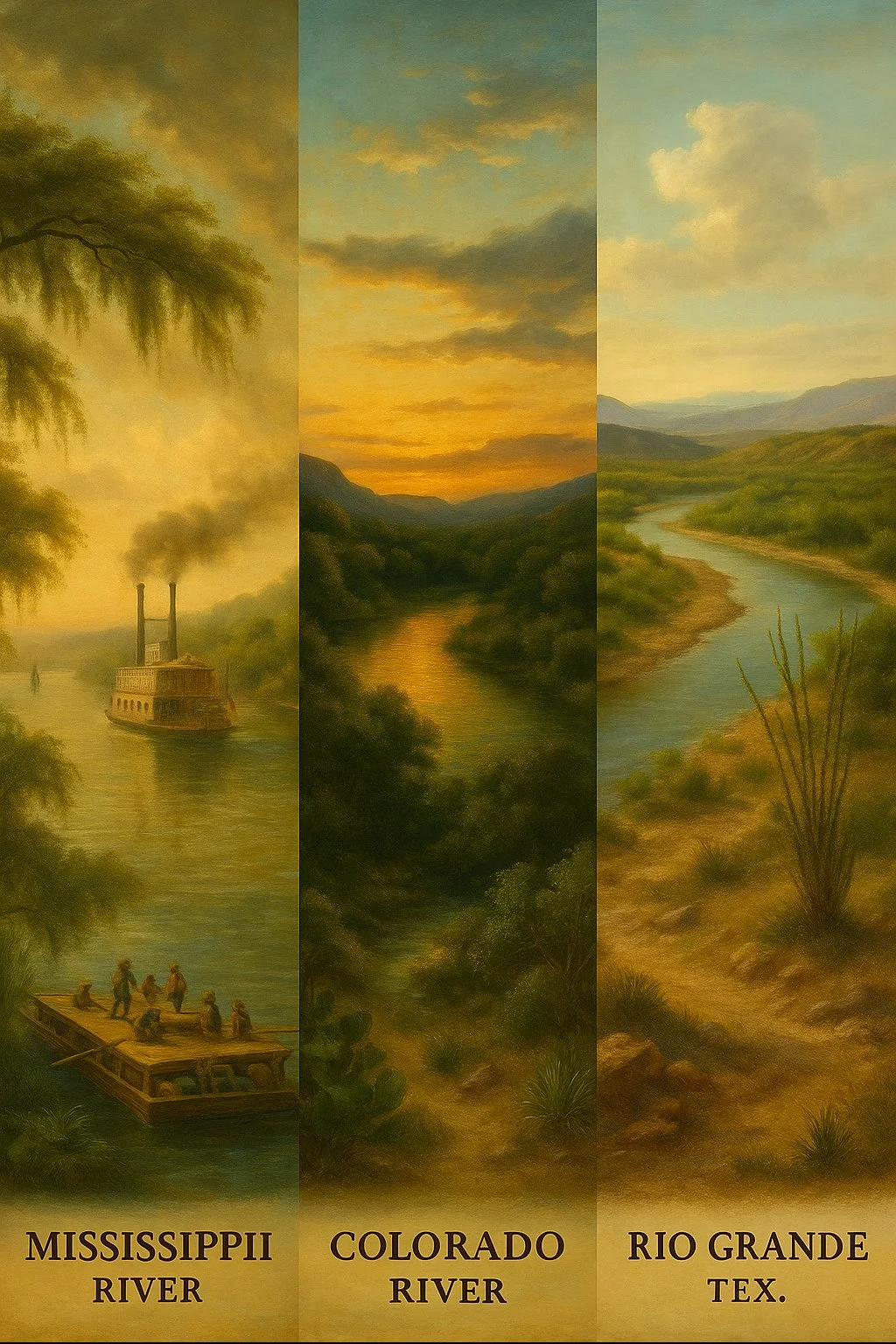
Three Rivers
The Webber–Hector Legacy
The Descendant — A woman in the present. Narrator and witness. Carries a lantern throughout.
Silvia Hector Webber — A woman of African descent, 20s through 60s. Dignified. Precise. Does not perform suffering.
John Ferdinand Webber — A white man from Vermont, 30s through 70s. Quiet conviction. Speaks plainly.
Voices — Ensemble. Speak as law, ledger, neighbor, soldier, census taker. No individual names.
A bare stage. Three rivers suggested by sound. A lantern. A chair. A folded document. The lantern is lit once and never extinguished. Dialogue from historical figures is imagined. The archive is real.
Running time: 16–19 minutes
Prologue
[THE DESCENDANT enters carrying an unlit lantern and a folded document. She sets both on the chair. She faces the audience.]
Descendant
Three rivers.
That is how I learned to hold this story.
Not as a single line of history moving forward —
but as water. Branching. Returning. Carving.
[She picks up the lantern. Lights it.]
My great-great-great-grandfather was a man from Vermont
who walked into Mexican Texas in 1823
and did something the world around him called impossible.
My great-great-great-grandmother was a woman born enslaved
in Spanish West Florida around 1807
who survived what the world called inevitable.
Together they built what both worlds said could not exist.
This is not a story of simple triumph.
It is a story of three rivers.
And what had to be crossed to reach the other side.
[Sound: the Mississippi — wide, heavy, slow.]
I. The Mississippi — Loss
[Cold light. VOICES arrange themselves in a line, facing away from the audience. They speak without turning.]
Voice 1
East Baton Rouge Parish.
Voice 2
July 9, 1816.
Voice 3
Estate of Dr. Samuel Flower, deceased.
Voice 1
Sarah. Female. Age twenty-six. Value: six hundred dollars.
Voice 2
Sylvia. Female. Age about nine. Value: three hundred and fifty dollars.
Voice 3
Mom and girl inventoried separately.
[Silence.]
Descendant
Three words.
Mom and girl inventoried separately.
The notary wrote them as procedure.
I read them as the end of a world.
[SILVIA appears, age nine, still. She does not move. THE DESCENDANT speaks to and around her.]
Descendant
Her name was Silvia.
Her mother’s name was Sarah.
The man listed beside them — no age, no relation — was named Hector.
Worth one hundred dollars.
Listed as sold individually.
She would carry his name for the rest of her life.
Silvia Hector.
A name chosen. Not assigned.
Voice 1
March 10, 1819.
Voice 2
Clark County, Arkansas.
Voice 3
Sold. Silas McDaniel to Morgan Cryer. Five hundred and fifty dollars.
[SILVIA is now older — twelve. She does not speak. She watches.]
Descendant
She had been counted.
She had been priced.
She had been moved.
The Mississippi does not care what it carries.
It only moves.
[Sound: the Mississippi fades. The Colorado rises — narrower, faster, contested.]
II. The Colorado — Defiance
[Warmer light. JOHN enters from the opposite side of the stage. He and SILVIA occupy the same space without yet acknowledging each other.]
Descendant
He came from Vermont.
He had served in a war and survived it —
a private in the 31st Infantry, in the War of 1812.
He had come to Texas for land.
He did not come expecting her.
[JOHN and SILVIA turn toward each other. A long pause.]
John
I have a land grant.
On the Colorado.
I intend to build something.
Silvia
What you build depends on what you decide.
[Pause.]
John
I know what I decide.
Descendant
June 11, 1834.
San Felipe de Austin.
Before Alcalde R. M. Williamson.
Four witnesses.
[THE DESCENDANT lifts the folded document from the chair. Holds it.]
Descendant
He pledged half his land.
He pledged his future.
He pledged himself as debtor
so that she and their children could be named free.
Voice 1
The bond requires delivery of two enslaved children in compensation.
Voice 2
By October 31st.
Voice 3
Failure to deliver increases the obligation.
Descendant
The children were never delivered.
The land was forfeited.
The ground itself was lost.
But Silvia walked free.
And the children walked with her.
[SILVIA stands fully upright. JOHN stands beside her.]
Silvia
They wrote my name in that bond.
They wrote my children’s names.
I am not grateful to the paper.
I am grateful to nothing that should not have held me.
But I am still here.
And that is mine.
[VOICES turn, now facing the audience. They speak as neighbors, as the Republic, as hostility.]
Voice 1
This is not how it is done.
Voice 2
This family is not legal.
Voice 3
Texas is a Republic now. The old rules do not apply.
Voice 1
Their marriage is voided.
Voice 2
Their children are a problem.
Voice 3
Their presence is a provocation.
[JOHN steps forward toward the VOICES. He is calm.]
John
My family is on this land.
My children will be taught.
My wife will not eat in anyone’s kitchen
unless it is her own.
[Pause. The VOICES do not move. Then:]
Voice 1
Drive them out.
[JOHN does not flinch. But the light shifts — colder.]
Descendant
1851.
The Texas State Historical Association records it plainly:
the family was pushed out of Travis County.
The land pledged for freedom
was forfeited to the man who had held her.
Who used it to pay his debts.
The prairie kept their name.
Webberville.
A town named for a family
driven out before the name was fixed to any map.
[Sound: the Colorado fades. The Rio Grande rises — deep, wide, borderless.]
III. The Rio Grande — Endurance
[Warm light returns, different from before — older, steadier. JOHN and SILVIA move south. THE DESCENDANT speaks as they walk.]
Descendant
They went south.
June 1853.
Hidalgo County.
El Agostadero de la Gata grant.
They built a ferry on the Rio Grande.
Official. Licensed. Documented.
And on the other side of that river
was Mexico.
Where slavery had been abolished.
Where no marshal could follow.
Where the river did the work that law refused to do.
[Three quiet knocks. SILVIA turns toward the sound.]
Silvia
I hear it.
[She moves. She opens something invisible. A pause.]
Silvia
Come in.
Eat first.
Then we move.
[She returns to her place. JOHN watches the river.]
John
When the war comes
we will not stand for the side that stands for this.
Silvia
I know.
John
We may have to cross.
Silvia
I have crossed before.
I know how it is done.
[VOICES now speak as Confederate forces, as history tightening.]
Voice 1
Texas has seceded.
Voice 2
Your sons are under arrest.
Voice 3
Unionists are not welcome here.
[JOHN and SILVIA cross to the other side of the stage. Mexico. The light warms again.]
Descendant
They crossed the Rio Grande.
Their youngest learned to walk on that other soil.
Then the war ended.
And they came back.
[They return. Older now. The VOICES are gone.]
Descendant
1870. Hidalgo County.
The census finds them.
Landowners. Farmers.
Surrounded by their children.
Voice 1 — softly, as census taker
Name.
John
John F. Webber.
Voice 1
Occupation.
John
Farmer.
Voice 1
And the woman.
John
My wife.
Voice 1
Her name.
Silvia
Silvia Webber.
Voice 1
Relation to head of household.
Silvia
Wife.
[A pause. The census taker writes. Light holds.]
Descendant
It took forty years
and a crossing into exile
before any census called her what she was.
Wife.
One word.
Forty years.
Epilogue
[JOHN and SILVIA stand together. THE DESCENDANT faces the audience. The lantern burns.]
Descendant
John Ferdinand Webber died July 19, 1882.
Near the river he had crossed for hope.
Silvia Hector Webber died September 13, 1892.
Her burial disputed — two communities claimed her.
She was large enough for two geographies.
They left eleven documented children.
And a line that runs to me.
[JOHN and SILVIA exit slowly. THE DESCENDANT remains. She holds the lantern toward the audience.]
Descendant
Three rivers.
The Mississippi took her mother.
The Colorado took their land.
The Rio Grande gave them a way to stay alive.
None of those rivers gave them anything easily.
All of them are in my blood.
This is not where the story ends.
You are where the story ends.
Every one of you
who carries this forward.
[She sets the lantern down. It continues to burn as the lights fade.]
[Blackout.]
Three Rivers is designed for minimal staging. One lantern. Three playing areas — Mississippi, Colorado, Rio Grande — suggested by light rather than set. VOICES require no costume beyond plain dress. They are the archive, not characters. The folded document THE DESCENDANT carries is the 1834 emancipation bond. It is never opened on stage. All historical events depicted are documented. Dialogue is imagined. The archive is real.
© 2025–2026 Debra E. Ortega
JohnFerdinandWebber.org | SilviaHectorWebber.com