

JohnFerdinandWebber.org · Literary Nonfiction
The Other Signature
A Reckoning with John Ferdinand Webber
Acknowledgments
This work would not have been possible without the generous assistance of the Dolph Briscoe Center for American History at The University of Texas at Austin and the Louisiana State Archives, whose collections preserved the documents that made this research possible.
I am grateful to the descendants who preserved family history across generations, often in the face of legal and social systems designed to erase it. Their memory kept Silvia’s name alive long before the archive could confirm it.
Special thanks to the archivists, librarians, and researchers whose careful stewardship of fragile documents made it possible for me to hold those papers in my hands — and to the readers who will carry these stories forward.
Author’s Note
This work is a work of literary nonfiction. It is grounded in primary sources, archival records, and genealogical research. Where the historical record is silent, I have allowed myself the space of reasoned imagination — not to invent, but to inhabit.
The documents that survive are fragments. Ledgers, bonds, census records, pension applications. They tell us what the law required, what the state counted, what the market valued. They do not tell us what Silvia felt when she was separated from her mother. They do not tell us what John thought when he signed the bond.
But silence is not emptiness.
In the gaps between documents, I have listened for what the archive does not say. The reflections that follow are offered as interpretation, not evidence. They are my attempt to sit with the weight of inheritance — the beauty and the harm, the love and the loss, the signature that binds us all.
Some names have been preserved. Others have not. The children promised as collateral in the 1834 bond have no names that survive. I have not invented them. I have only acknowledged their absence.
This is not a complete history. It is a reckoning.
A Note on Sources and Method
This work rests on three categories of evidence:
1. Documented Fact. Dates, names, legal instruments, and official records that can be verified through primary sources. These form the fixed points of the narrative.
2. Reasoned Interpretation. Where documents survive but are silent on certain questions — motives, emotions, private conversations — I have allowed myself the space of interpretation. These passages are clearly presented as what I imagine, not what I know.
>3. Family Tradition. Oral history passed down through generations. Where I have drawn on such tradition, I have identified it as such. These traditions are valuable not as evidence of specific events but as evidence of how the family has chosen to remember itself.
Any future discoveries of new primary-source material may refine or revise the interpretations offered here. Until then, this narrative represents my best effort to sit with the available evidence — and with its silences.
Chapter One — Vermont, 1794
The snow in Danville, Vermont, falls differently than the dust of the Rio Grande.
I have never seen Danville in winter. But I imagine it — white fields stretching toward bare maples, smoke curling from stone chimneys, the Green Mountains holding the horizon like a promise.
Into this cold, on a day no one recorded with certainty, John Ferdinand Webber was born.
The exact year of John Ferdinand Webber’s birth remains disputed. Some published sources repeat an earlier birth year of 1786, while the reconstructed family chronology — including the documented 1792 marriage of John Webber and Hannah Morrill — supports a birth closer to 1794–1795. Throughout this narrative, I follow the later chronology while acknowledging the surviving discrepancy in the historical record.
But the place is clear: Danville, a small town in Caledonia County, near the border with New Hampshire.
The strongest surviving genealogical and documentary evidence identifies his parents as John Webber and Hannah Morrill. In the family’s New England naming tradition, descendants often preserved maternal surnames as middle names. Thus genealogical records frequently identify them as John Webster Webber Jr. and Hannah Kittredge Morrill, preserving the maternal Webster and Kittredge family lines across generations.
I want to know what Hannah dreamed for her son.
I want to know if she ever imagined he would one day sign a document that would outlive her by two centuries — a document I would hold in my hands, sweating through cotton gloves, searching for the man behind the ink.
The archive gives me dates. Pension applications. A signature.
The rest is silence.
And yet.
That signature did not appear from nowhere. The man who made it was shaped by something — by the War of 1812, by the long march southwest, by the borderlands where law changed as often as the river flooded.
By her.
Silvia.
I cannot understand the bond without understanding him. And I cannot understand him without understanding where he began.
So I start here. Danville, Vermont. 1794. A boy in the snow.
Chapter Two — The War
The war came for him before Texas, before Silvia, before the river.
Long before he became the man whose signature would one day lead me into an archive, John Ferdinand Webber was simply another young American who answered his country’s call to arms.
Why he enlisted, I cannot say. Perhaps it was patriotism. Perhaps it was opportunity. Perhaps, like thousands of young men of his generation, military service offered a wage, a purpose, or simply a path beyond the place where he had been born. The records do not tell me. They rarely tell us why.
But they do tell us that he served.
On May 23, 1813, John Ferdinand Webber enlisted as a private in Captain S. Dickinson’s Company of the 31st United States Infantry. His service continued until May 31, 1814, during one of the most uncertain periods of the War of 1812.
Years later, when age had overtaken youth, that service returned to him in the form of a pension. After his death, Silvia applied for a widow’s pension based upon the same military record, preserving in government files one of the clearest documentary threads of their shared life.
The files are surprisingly modest. A few dates. A regiment. Official certifications. A soldier reduced to paper.
The archive preserves his service. It does not preserve the man.
John’s company participated in the Battle of Shadage Woods, one of the engagements recorded in his military history. Beyond that, however, the surviving documents become remarkably quiet. They do not tell me where he slept. They do not tell me whom he befriended. They do not tell me whether he was frightened. They do not tell me whether he ever believed he would die.
The silence is almost startling. Government records excel at counting men. They rarely explain them.
I searched for evidence that the war left a visible mark upon him. A wound. A disability. A lingering illness. Nothing in the surviving record suggests that he carried home a permanent physical injury. If the war scarred him, it did so in ways no pension examiner could measure.
When his enlistment ended in 1814, John Ferdinand Webber did not return to live the quiet life of a Vermont farmer. Like many veterans of his generation, he became part of the great migration pushing the American frontier steadily west and south.
While John wore the uniform of the United States Army, Silvia Hector was still a child, hundreds of miles away in the borderlands of the Gulf South, where her own future was being shaped by forces entirely different from his. She had not yet been inventoried in the probate records of the Flowers estate. She had not yet been sold. She had not yet crossed into Mexican Texas. She almost certainly knew nothing of the war that occupied the young soldier from Vermont.
Their lives moved on separate paths. One in military service. One in bondage. Neither could have imagined that those paths would eventually converge on another frontier.
Chapter Three — The Long March South
After the war, John did what thousands of other discharged soldiers did: he moved.
The records are thin for the years between 1815 and 1826. He appears in the expanding Southwest before his documented presence in Austin’s Colony. The precise sequence remains incomplete, but his migration mirrors that of thousands of veterans who sought opportunity beyond the established states.
Each mile south carried John into a different world. The New England of his childhood was giving way to the plantation South. The farther he traveled, the more visible slavery became — not as an abstract political argument but as an everyday institution woven into the economy, the landscape, and the lives of those who lived there.
Whether John accepted what he saw, questioned it, or simply regarded it as part of the world around him, the surviving record does not say. I resist the temptation to answer for him. The silence belongs to history. Not to me.
In 1821, Mexico secured its independence from Spain. The new republic inherited an enormous northern frontier that included Texas. Hoping to encourage settlement, the Mexican government invited foreign colonists to establish communities under carefully negotiated conditions. Mexico officially moved away from slavery after independence, yet many of the Anglo settlers arriving from the United States came from societies where slavery was deeply entrenched. The result was a frontier filled with contradictions. John entered that complicated world. He did not create its contradictions. But he would eventually be forced to live inside them.
While John traveled toward Texas, another journey was unfolding hundreds of miles away. Silvia Hector had already endured separation from her mother in the probate inventory of the Flowers estate. She had already entered the marketplace where human beings were assigned prices. Before long she would be carried west by John Cryer into Mexican Texas. Neither of them knew the other existed. The distance between them was shrinking — not because either sought the other, but because the borderlands were drawing them both toward the same place.
Chapter Four — The Arrival
The archive grows louder.
For nearly a decade after the War of 1812, John Ferdinand Webber drifted in and out of the historical record like a figure seen through morning fog. Then, almost suddenly, the documents begin to accumulate. Land. Settlement. Responsibility. The wandering years were ending. History had finally caught up with him.
Documentary evidence places him in Austin’s colony by the mid-1820s, and by June 22, 1832, he had secured a headright of more than 2,200 acres along the Colorado River. The land represented far more than property. It represented permanence.
The records portray an industrious man. He claimed land. He met legal requirements. He participated in the civic life expected of colonists. Nothing in those early documents suggests that history would one day remember his name. He appears, at first, almost ordinary. I have come to appreciate ordinary. History is built from ordinary people whose lives become extraordinary only when viewed across generations.
Somewhere within that complicated world, another life was unfolding. Silvia Hector had already crossed into Mexican Texas. She had not come as a settler. She had not chosen the journey. She had been brought by John Cryer, the latest man to claim legal ownership over her life. She arrived carrying none of the freedoms John carried. No land grant. No headright. No legal standing beyond the status someone else assigned to her.
Their introductions survive nowhere in the archive. No diary records their first conversation. No letter remembers the day they met. No witness described the moment. The archive has earned the right to keep some of its mysteries.
What I can say is this: at some point, two lives that had begun hundreds of miles apart entered the same landscape. One belonged to a free veteran from Vermont. The other belonged to a woman whom the law still regarded as property. The distance between them could be measured in only a few steps. The distance created by law was immeasurably greater. And yet, somehow, that distance was crossed.
Chapter Five — The Encounter
She was not free.
Let me sit with that.
When John met Silvia, she was still enslaved. She belonged to John Cryer, who had brought her from Arkansas to Texas. She had already been sold twice. She had already been separated from her mother. She had already learned that the world was not kind to women like her.
Whatever first drew John to Silvia, his later actions demonstrate that he ultimately chose to recognize her humanity in ways many of his contemporaries did not.
The laws of Mexican Texas did not forbid interracial relationships outright — not yet. But Anglo settlers were beginning to impose their own racial codes, even as Mexico’s laws remained ambiguous. He crossed a line. He did not cross it alone.
Chapter Six — The Bond
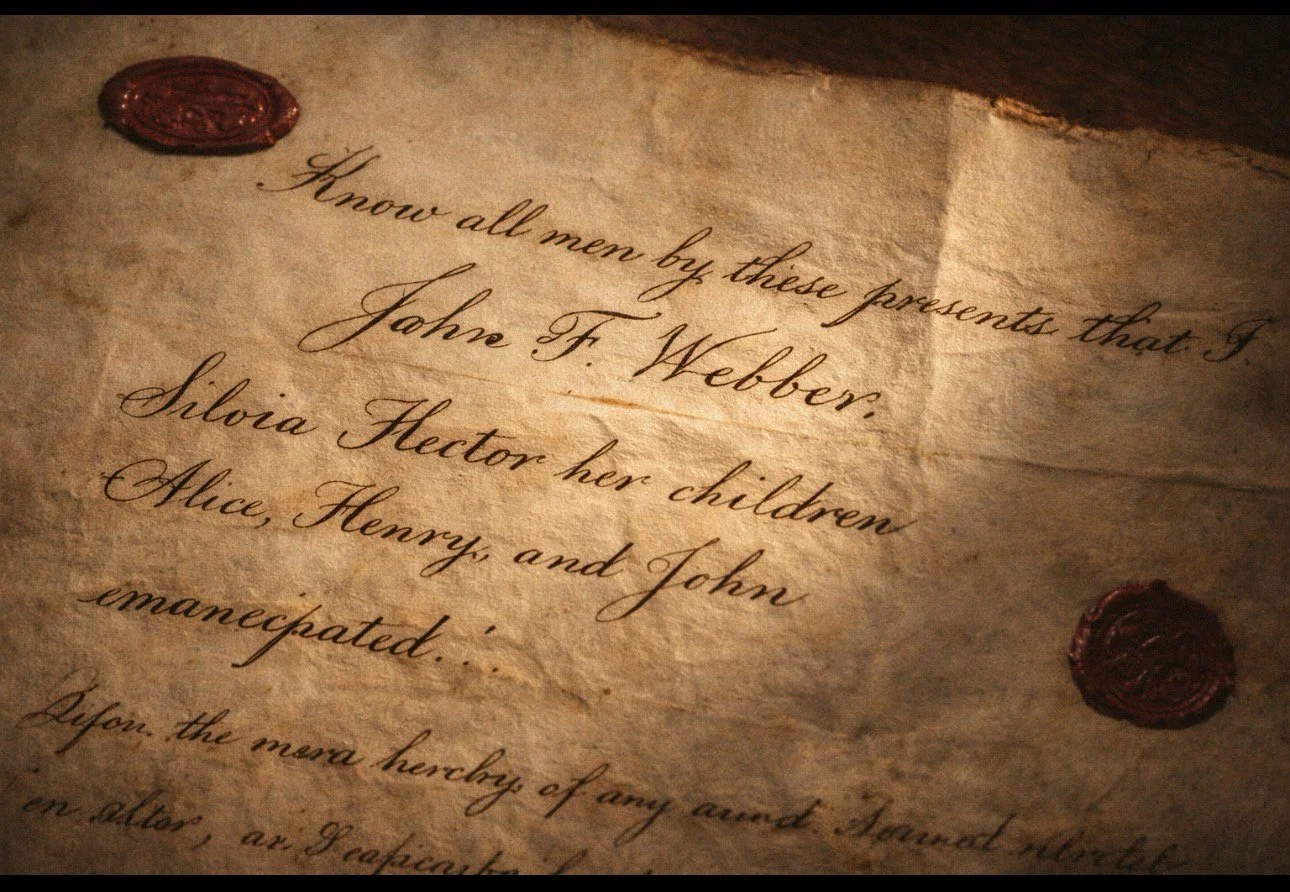
June 11, 1834. San Felipe de Austin. The document that would change everything.
John Ferdinand Webber appeared before Alcalde Robert McAlpin Williamson and executed an emancipation bond for Silvia Hector and their children. The bond is the heart of this story. It is also its wound.
The language is formal. Detached. Almost emotionless. John bound himself to deliver “a negro girl three years of age” and “a negro boy two years old” should he fail to fulfill the obligations required by law. No names. Only ages. Only value. Children reduced to legal guarantees.
I have read those words dozens of times. They have never become easier.
The contradiction did not originate with John alone. It existed within the legal system itself. Mexican authorities increasingly opposed slavery, yet emancipation often required bonds intended to ensure that newly freed people would not become public charges or later be returned to slavery through legal disputes. The requirement was bureaucratic. Its consequences were profoundly human. John accepted those legal conditions because they were the mechanism by which Silvia and her children could become legally free. Understanding that history is essential. It does not erase the moral violence of the document. Neither does it excuse it.
The law demanded an impossible calculation. Freedom for one family rested upon the legal possibility of bondage for another. Some contradictions cannot be resolved. They can only be acknowledged.
Then I reach the bottom of the page. There it is. John Ferdinand Webber’s signature. Steady. Confident. Practiced. It is only ink. Yet it carries extraordinary weight.
For years I believed that signature was the center of this document. I no longer think so. Because every time I look at it, I also see the people whose names history never recorded. The unnamed children promised as collateral. The clerk who copied the language. The officials who enforced it. And Silvia herself — present, central, yet speaking only through the decisions others placed upon paper.
The bond does not record a conversation. It tells me nothing about the night before. Nothing about the fears they carried. Nothing about the hopes they dared to imagine. The archive remains silent. Its silence is frustrating. It is also honest. History is often far better at preserving procedure than preserving people.
For years I wanted this document to resolve my questions. Instead, it multiplied them. I wanted certainty. Instead, I found contradiction. I wanted a hero. Instead, I found a man willing to accept an unbearable legal bargain in order to free the woman he loved. I wanted innocence. History rarely offers it.
The bond stands exactly where it has stood since June 11, 1834. The paper has not changed. The ink has not faded enough to erase what happened. Only the reader changes.
Interlude — The Other Signature
I had looked at the bond for years before I realized I had been looking at only half of it.
John’s signature is impossible to miss. It moves confidently across the page in practiced script, the handwriting of a man accustomed to signing legal documents, land papers, and official records. It is the signature history preserved.
For a long time, I believed it was the reason this document mattered.
I was wrong.
Because just beyond that signature stands someone whose presence history never expected to preserve — Silvia, named in the bond as the person whose freedom was being secured, present in the transaction as its named beneficiary, not as a signatory, yet the reason the document exists at all.
She left almost no written words behind. No diary. No letters. No memoir. The archive remembers her mostly through documents created by other people — probate inventories, bills of sale, emancipation papers, census records, and pension files. Again and again, someone else held the pen. She lived inside records she did not write.
That realization changed the way I read the bond.
John signed it.
Silvia lived it.
His signature occupies only a few inches of paper. Her life occupies every page that follows.
For generations, historians looked for the names of men. The records made that easy. Women like Silvia often appear only when governments counted them, valued them, transferred them, freed them, widowed them, or buried them. Even then, their own voices remain difficult to hear.
Perhaps that is why descendants matter. We ask different questions than governments asked. We do not begin by asking who owned the land. We ask who carried the family. We do not begin with property. We begin with people.
John’s signature brought me to the archive. Silvia kept me there.
The more I studied the document, the less interested I became in the ink itself. What mattered was everything the ink could not say. It could not describe courage. It could not measure endurance. It could not record the ordinary tenderness required to build a family under laws that denied the legitimacy of that family. It could authorize freedom. It could not explain what freedom felt like.
For years I thought this book was about one signature. Now I know it is about another. Not one written in ink. One written in a life.
Perhaps that is the only signature history almost erased. Perhaps it is the one I inherited. And perhaps that is the one I have been trying to read all along.
Chapter Seven — The Prairie Years
After the bond, John and Silvia built a life.
They settled at Webber’s Prairie, a community in what is now Travis County, Texas. The land was fertile, the community small, the risks constant.
They raised their growing family there — eleven documented children. The children born before the bond were freed by it; those born after were born free.
I imagine the prairie at dawn. The light spreading across the grass. Silvia at the door of their cabin, watching the horizon. John in the fields, his hands calloused from work. They were free. But freedom was fragile.
The Republic of Texas legalized slavery in 1836. It banned free Black immigration and created a legal regime that did not recognize their union, did not protect their children, and did not hesitate to threaten their existence. Their children could not attend school with white children; they hired a private tutor. Neighbors turned suspicion into hostility.
And yet. They stayed. They built. They survived.
Chapter Eight — The Ferry
By 1853, the Webbers had relocated to the Rio Grande.
The reasons are unclear. Perhaps they fled rising racial hostility in central Texas. Perhaps they sought new opportunities in the borderlands. Perhaps they simply followed the logic of their own survival. Whatever the reason, they settled on the river, on a tract known as the Agostadero del Gato Land Grant.
Later regional research identifies a ferry landing or ferry operation on their property. No contemporary ferry license has yet been located. But the river was there, and the river was a border, and a border is also a passage.
Family tradition remembers the ferry as a place where freedom crossed the Rio Grande. While surviving documentary evidence is limited, that tradition aligns with the broader history of the borderlands, where Mexico became a refuge for people escaping slavery.
I imagine them pulling a boat across the water, the river quiet, the stars bright overhead. I imagine the passengers — men, women, children clutching their belongings, their hopes, their terror. I imagine Silvia watching them step ashore, her face unreadable, her heart full.
Neighbors gave her a name she did not choose — a diminishing nickname that said more about the assumptions of the people who used it than about the woman they thought they knew. That name is not hers. Her name was Silvia.
This is not in the bond. This is not in any record I have found. But this is what survives in memory.
Chapter Nine — The Mexican Exile
1861. Texas seceded from the Union. The Confederacy demanded loyalty. The Webbers opposed secession. They took refuge in Mexico.
Family records and later accounts indicate that several of the Webber sons were arrested because of the family’s Unionist sympathies. One escaped and warned Union forces near Fort Brown, underscoring the risks the family accepted by refusing to support the Confederacy.
The decision was not easy. They left behind land, property, community. They crossed into a foreign country, uncertain of what they would find.
But they did not stay.
After the war ended, in May 1865, they returned to Texas. The family was intact. The children who had been born in Mexico were now part of the family story — their births recorded in Mexican records, their lives shaped by the borderlands that had become their home.
John was an old man by then. His signature was still on the bond. But he had lived long enough to see the world change.
Chapter Ten — The Reckoning
I sit with the weight of him.
John Ferdinand Webber is not a simple figure. He is not a hero. He is not a villain. He is a man — flawed, complicated, driven by forces he may not have understood.
He loved Silvia. He freed her. He built a life with her.
And he signed a document that promised children as payment.
I searched for a way to reconcile those truths. I tried to separate them, to weigh them against each other, to find a calculus that balances the harm against the good. There is no such calculus. The bond stands. The ferry stands. And I stand between them, trying to make sense of a man I will never fully understand.
Chapter Eleven — The Signature Remains
1882. John Ferdinand Webber died near the Rio Grande on July 19, 1882. He was old — perhaps eighty-eight, perhaps closer to ninety-six. He had outlived the Republic of Texas. He had outlived the Confederacy. He had outlived most of the people who had known him in his youth.
He died on the land he had claimed, the river he had crossed, the border he had made his own. He was buried in Webber Cemetery, Hidalgo County, near Donna, Texas.
And he left behind a document. Box 2H484. The bond. The signature. The reckoning.
Epilogue — The Descendant Returns
I hold the document again. The ink is faded. The paper is fragile. The language is cold. But I am not the same person who opened the box the first time.
I have walked through the years with him now. I have imagined his boyhood in Vermont. I have seen him in the war, in the colony, in the bond. I have followed him to the prairie and the river and the refuge.
I have spent years trying to understand him.
And I have failed.
But maybe that failure is not the end. Maybe understanding is not the point. Maybe the point is to sit with the weight of him — the beauty and the harm, the love and the loss, the signature that binds us all.
I do not absolve him.
But I do not forget him.
He is mine to reckon with.
And I am his to remember.
Sources
Primary Sources
East Baton Rouge Probate Inventory of Dr. Samuel Flowers, July 9, 1816. Louisiana State Archives.
Emancipation Bond for Silvia Hector and Children, June 11, 1834. Dolph Briscoe Center for American History, Earl Vandale Collection, Box 2H484, The University of Texas at Austin.
John Ferdinand Webber, service record, Captain S. Dickinson’s Company, 31st U.S. Infantry, War of 1812. National Archives and Records Administration (NARA).
John F. Webber pension application and Silvia Webber widow’s pension application (1871–1882). NARA War of 1812 pension files. Pension certificates S.C. 20941 and W.C. 33717.
Texas General Land Office. Land grant records. Headright grant to John Ferdinand Webber, June 22, 1832.
U.S. Census records, 1850 (Travis County) and 1880 (Webber’s Rancho, Hidalgo County).
Secondary Sources
Baumgartner, Alice L. South to Freedom: Runaway Slaves to Mexico and the Road to the Civil War. New York: Basic Books, 2020.
Campbell, Randolph B. An Empire for Slavery: The Peculiar Institution in Texas, 1821–1865. Baton Rouge: Louisiana State University Press, 1989.
Hammack, María Esther. “Webber, Sylvia Hector.” Handbook of Texas Online. Texas State Historical Association, March 20, 2024.
Muir, Andrew F. “Webber, John Ferdinand.” Handbook of Texas Online. Texas State Historical Association, 1976; revised March 20, 2024.
Torget, Andrew J. Seeds of Empire: Cotton, Slavery, and the Transformation of the Texas Borderlands, 1800–1850. Chapel Hill: University of North Carolina Press, 2015.
Family Research and Oral Tradition
Webber family genealogies and reconstructions. Various collections.
Family oral history regarding ferry operations, refuge activities, and the Webber family’s Unionist sympathies during the Civil War.
© 2024–2026 Debra E. Ortega · JohnFerdinandWebber.orgv2 · 23 July 2026 · Five council fixes applied