

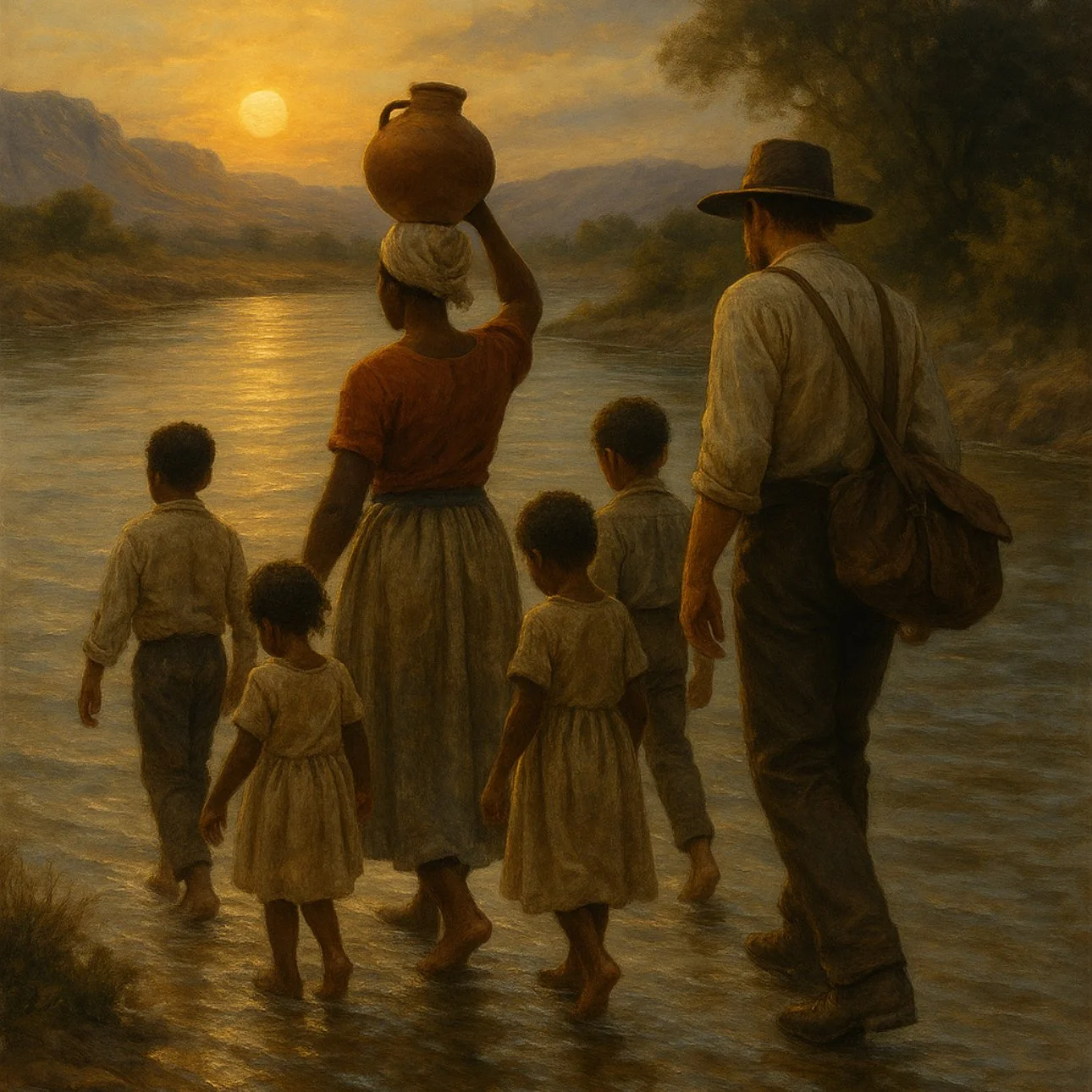
Outcasts of the Land
A One-Act Play Inspired by the Lives of John Ferdinand Webber and Silvia Hector Webber
Narrator — A modern-day descendant, reading and reflecting on Smithwick’s memoir.
John Ferdinand Webber — A white settler from Vermont, a veteran of the War of 1812.
Silvia Hector Webber — A free Black woman and matriarch, formerly enslaved.
Noah Smithwick — A white neighbor and chronicler, observing the Webbers’ lives.
Tutor — An Englishman hired to educate the Webber children.
Ensemble — Voices of settlers, neighbors, townspeople, children.
Minimalist stage with movable set pieces: a writing desk (for the Narrator), a log cabin porch, a ferry silhouette, cotton fields, and riverbank. Projections and lighting shifts suggest time, place, and memory.
1. The Name in the Margins
[Spotlight on the NARRATOR at a writing desk, reading from an aged book. Dim light reveals JOHN and SILVIA in tableau.]
Narrator — softly
When I turned the page and saw it — Webber — my breath caught.
There it was, written by a man who claimed to know them:
“Webber took his family home and acknowledged them before the world…”
But he did not call her Silvia.
He called her by something smaller — a pet name, the kind white society pressed onto Black women to keep them tame.
As if she were not a matriarch but a servant.
I will not repeat it.
Her name was Silvia Hector.
My grandmother’s grandmother’s grandmother.
[Lights up on SILVIA, tending to bread on a hearth. JOHN stands nearby, protective, resolute.]
2. Entangled in Love
Smithwick — from the side, reading aloud
“He became entangled in a low amour…”
Narrator
Entangled.
Low.
Amour.
As if love were a mistake.
As if my family were an error in the story of Texas.
[JOHN kneels before SILVIA, holding emancipation papers. She takes them with quiet sorrow and strength.]
John
It’s done. You’re free. And so is our child.
Silvia — quietly
Freedom bought, and never fully paid.
(stares into the distance)
But we’ll make something honest from it.
[They clasp hands. Lights dim.]
3. Between Two Worlds
[A cabin interior. Children’s laughter offstage. SILVIA weaves. Neighbors’ voices echo faintly from the dark.]
Ensemble Voices
“She’s good with bread…”
“Knows herbs, too. Pity she’s—”
“Not one of us.”
Smithwick
“There wasn’t a white woman in the vicinity but knew and liked—”
[The NARRATOR stops. She will not finish the sentence with the name Smithwick used.]
Narrator
They needed her when sickness came. When mouths went hungry.
And she gave freely.
But never once did they call her by her name.
(softly)
Silvia. Silvia. Silvia.
4. Seeds of Envy
[Lights shift to a riverbank. The ferry rests nearby. JOHN and an ENGLISH TUTOR talk.]
Tutor
I can teach your children. They’re quick. Bright.
John
Then you will.
[Whispers rise from the shadows.]
Ensemble Voices
“They’re letting slave children read?”
“What influence will they have on our own?”
“Drive the tutor out.”
[SMITHWICK steps forward.]
Smithwick
“I abhorred the situation. But I honored the man for standing by his children — whatever their complexion.”
5. The Last Meeting
[Mesquite trees. Crickets. JOHN and SMITHWICK meet at twilight.]
Smithwick
There’s freedom in Mexico.
No one cares about color there.
No man will call your children what they call them here.
John — silent, then
I’ve been thinking the same.
Not just for me. For them.
[They sit in silence. The weight of exile fills the air.]
6. Across the River
[The ferry stage piece slides across as lights shift blue. SILVIA, JOHN, and CHILDREN step onto it.]
Narrator
Smithwick’s memoir ends here.
“He took my advice, and I never afterward saw or heard of him.”
But family memory continues the story.
[Projected text appears: “Tamaulipas, Mexico — 1850s”]
They crossed the river.
And they lived — not as fugitives,
but as themselves.
7. What Remains
[Lights return to the NARRATOR at the desk.]
Narrator
When Smithwick’s daughter published his memoir,
she didn’t know what it meant to me.
To us.
She preserved their names — barely.
She dimmed their dignity.
But their love lit the way forward.
This is for Silvia, who gave bread to the hungry.
For John, who stood before the world with truth.
For their children, who were never outcasts in their own home.
They were outcasts of the land.
But never outcasts of love.
[All characters return silently in tableau. SILVIA and JOHN at center, holding hands. Lights fade.]
JohnFerdinandWebber.org | SilviaHectorWebber.com