

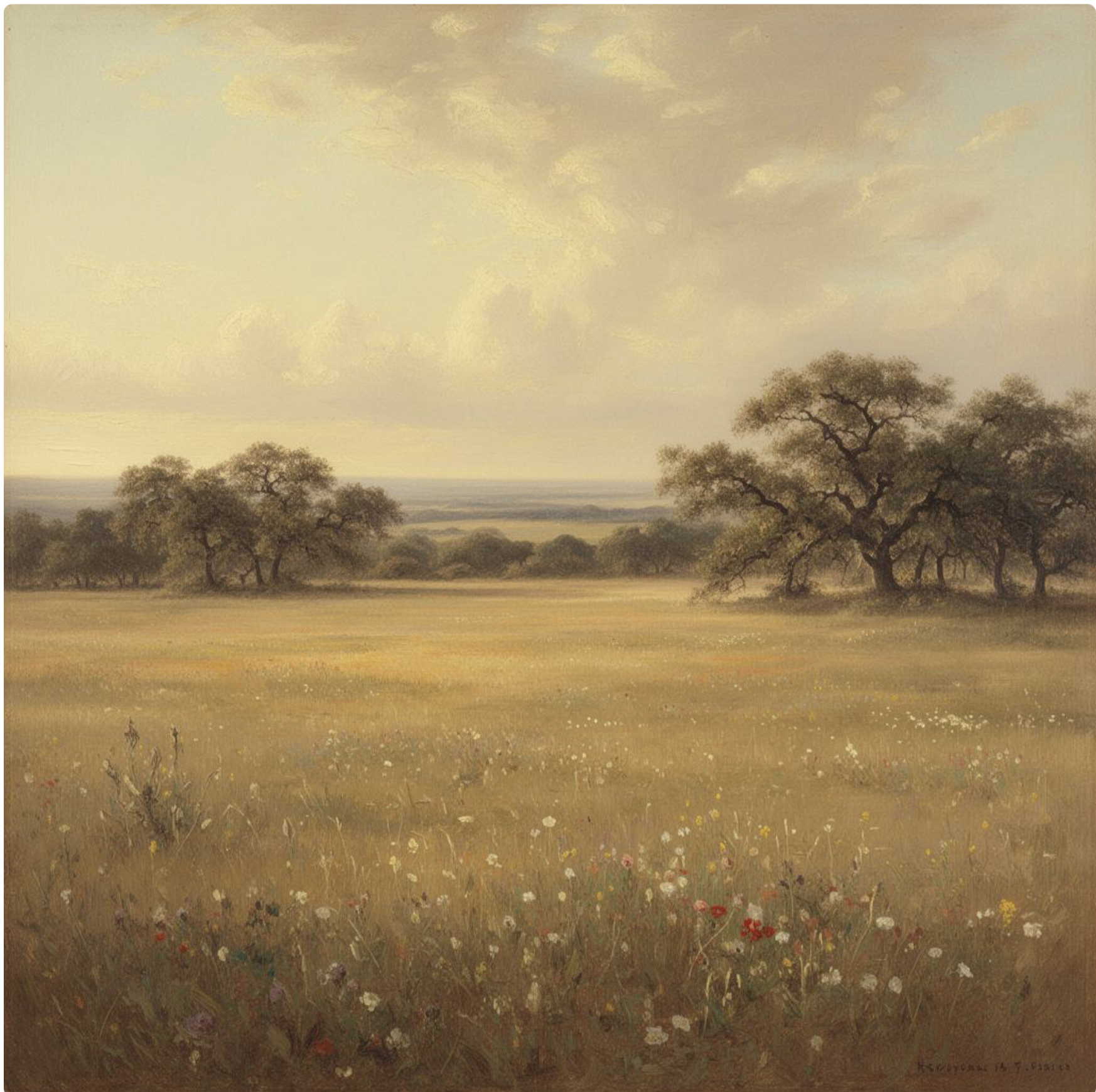
Before the Rivers Met
A Companion Essay
Before law, exile, and legacy, there was a young man crossing into Mexican Texas — building something lasting from open ground.
> “The land remembers what was built upon it.” > — Hector-Webber Family Oral Record
This companion essay traces the early formation of John Ferdinand Webber before the defining struggles of exile, interracial family life, and resistance along the Texas borderlands.
-
Roots in New England
John Ferdinand Webber was likely born in Vermont, possibly Danville, around 1794–1795, though records vary. Descendant lineage charts identify his parents as John Webber and Hannah Morrill. He came of age in a region shaped by quiet discipline, the Protestant traditions common to early New England communities, and a strong belief in personal responsibility. In the small towns of New England, a man’s reputation rested less on wealth than on steadiness of character.
These early surroundings instilled in him habits that would remain constant: self-reliance, reserve, and a sense that one’s word should carry weight.
-
Tempered by War
As a young man, Webber served in the War of 1812 as a private and medic in Captain Silas Dickinson’s Company of the 31st U.S. Infantry. His role was not one of command but of care — tending the wounded in harsh northern campaigns.
The work required composure under pressure and an acceptance of hardship without complaint. War did not make him famous, but it shaped him. He learned the fragility of life and the discipline of service — lessons that would later prove essential on the frontier.
-
Southward to Mexican Texas
In the early 1820s, like many veterans seeking opportunity, Webber traveled south into Mexican Texas. He joined Stephen F. Austin’s colony and, in 1832, received a land grant along the Colorado River in what would later become Travis County.
There he established a homestead later remembered in local and descendant tradition as Webber’s Fort. Reported remains of a brick foundation and cistern have been associated with the likely site. The surrounding community became known as Webber’s Prairie, eventually evolving into the village of Webberville.
On that land, Webber earned a reputation as practical and capable. He applied his medical knowledge where needed and contributed to the growth of a frontier settlement still uncertain of its political future. Mexican authority governed the region, Anglo migration increased steadily, and tensions simmered beneath daily life.
Yet during these years, Webber’s identity was that of a country man: clearing land, building structures, and helping shape one of the early Anglo settlements in the area.
-
A Man on the Threshold
By the early 1830s, John Ferdinand Webber stood as a veteran, landholder, and community founder. He had crossed one frontier — from Vermont to Texas — and secured a foothold in a contested landscape.
The qualities that defined him — steadiness, discipline, and a willingness to endure difficulty — were already formed. What lay ahead would test those qualities in ways neither war nor wilderness had prepared him for.
Before the rivers of his life converged — before law, exile, and legacy — there was simply a young man riding south with resolve, building something lasting from open ground.
And the land remembered.
⸻
John Ferdinand Webber: A Man Who Stood His Ground
A Biography of Courage and Commitment
A biographical narrative tracing JohnFerdinand Webber’s life from Vermont to the Rio Grande, exploring the moral and familial choices that shaped a borderland legacy.
Providing online non-downloadable historical narratives, archival interpretation, and educational content.
Foreword — The Choice
Most pioneer stories in Texas are told as conquest.
This one is different.
It is the story of a man whose defining act was not domination, but devotion—
The courage to choose his family.
And stand by them—
against law,
against pressure,
against time.
My name is Debra.
I am a descendant of John Ferdinand Webber and Silvia Hector Webber.
My search began with a quiet question:
How could a woman born into slavery come to hold land, family, and legacy across generations?
t emerged in fragments—
a deed,
a bond,
census page.
Each one marking a life built,
protected,
and carried forward.
Together, they reveal a single truth:
Love and loyalty outweighed law and prejudice.
This is not simply the story of a man who had a family.
It is the story of a man who chose them—
again and again—
-
Fact‑Check Note
This biography incorporates descendant oral history, archival documentation, census schedules, military records, land records, and regional historical scholarship.
Where documentary certainty remains incomplete, interpretive or descendant‑based claims are identified accordingly.
-
In Hidalgo County, along the Rio Grande, John Ferdinand Webber began again.
But not all crossings were recorded.
Some who crossed were not listed.
Some movements were not written down.
Silence, in the historical record, is not absence. It is often protection.
When the Civil War began, Texas aligned with the Confederacy.
Exile, even temporary, became part of the family’s story.
-
Over time, John Ferdinand Webber’s presence became embedded in record.
Name appeared again and again.
These entries represented continuity.
Land, once used to secure freedom, became the foundation for inheritance.
The story did not end with one act.
It extended through repetition—through daily life, work, and presence.
John Ferdinand Webber died in 1882—
on the land he had secured for his family.
Silvia Hector Webber lived on.
She carried memory—
and the record with it—
forward.
Family tradition holds that she later filed for his War of 1812 widow’s pension.
A document linking their private life—
to the official record of a nation.
Their graves are unmarked.
But their story is not.
It remains—
in the land once called Webber’s Prairie,
in the waters of the Rio Grande,
in the records that preserved them—
even when incomplete.
We remember not a man defined by conflict—
but by commitment.
Not by what he fought—
but by what he refused to surrender.
He chose his family.
He stood by them.
And because he did—
they remain.