The Archive · A Doorway
A Note on Names
Before you enter the documents, a word about why the names inside them will not always match.
A reader moving through this archive will notice that the same person is often written more than one way. John Ferdinand Webber appears in some records as Juan Fernando. His daughter Sarah Jane is also Juanita. His son James is Santiago. A name shifts from one document to the next, from one language to another, from one side of a border to the other.
This is not confusion in the record. It is the record telling the truth about the family’s life.
The Webber children were born in Tejas, Mexico — Mexican Texas, before it was ever the State of Texas. They grew up bilingual from birth, in a world where Spanish and English were spoken side by side. For them, Juan Fernando was not a translation of John Ferdinand, and Santiago was not a Spanish version of James. Both names were simply theirs, held at once, in a household and a country that lived in two languages.
The family held land under Mexican and then Texan and then United States law, and during the Civil War they crossed into Mexico and lived there in exile before returning. Their marriage itself was recorded in the language of the ruling law: they were wed by Father Michael Muldoon, a Catholic priest — the cleric available and willing to make an interracial union legal in Mexican Tejas, where Catholic rites were the law of the land. As the border moved across them — they did not move across it — each new sovereignty wrote their names, and their records, in its own hand. Sometimes a name shift was a matter of language; sometimes it was a matter of being counted, of being trusted, of being safe.
The same people, written more than one way
John Ferdinand = Juan Fernando
Sarah Jane = Juanita
James = Santiago
Henry = Leonardo
Elsie = Alicia · Clemencia
Rachel = Amanda · Raquel
To flatten these into a single “correct” spelling would erase the very thing they document: a family fluent in more than one world, adapting its name to survive in each. The variation is not the error. The variation is the evidence.
There is a second reason a name repeats in these records, and it is not linguistic but memorial. This family named its children for the ancestors it refused to forget. Sarah Jane carried the name of her grandmother Sarah — Silvia’s mother, the woman recorded in the 1816 probate and inventoried apart from her own daughter. The name was carried forward like an heirloom, and so were others: Juanita, Santiago, and more were given again and again to daughters and nieces across the generations that followed.
This is why the documents can be so difficult to untangle. A single record naming “Juanita Webber” may be Sarah Jane — or a niece, or a grandniece, born decades later and named in her honor. The name alone cannot tell you which. Only by tracing each person back to her parents does the generation come clear. What looks at first like one name repeated is in fact a family remembering itself, one namesake at a time.
The matriarch of this family carried her own name deliberately. Listed in a probate inventory only as property, she took in freedom the name Hector — the name of a man recorded in the same estate — and held it for the rest of her life, becoming Silvia Hector, then Silvia Hector Webber. The fuller story of how she chose and shaped her name is told in her own archive, at SilviaHectorWebber.com.
So as you read the documents that follow, let the differences stand. Each spelling is a footprint. Together they trace a family that refused to be reduced to one language, one country, or one name.
And the world that made them bilingual did not vanish. The land south of Austin, where this family lived and farmed and crossed the river, remains bilingual to this day. The border moved; the two languages stayed. The Webbers’ names were never a translation problem to be solved — they were, and are, the sound of a place that has always spoken in more than one tongue.
“They were not misrecorded. They were multiply recorded — because they lived in more than one world at once.”
Each document above carries an evidence tier — original record, compiled genealogy, or secondary biography. For how these sources are weighed before they enter the archive, see the Standards of Evidence on the Research page.
The Genetic Record
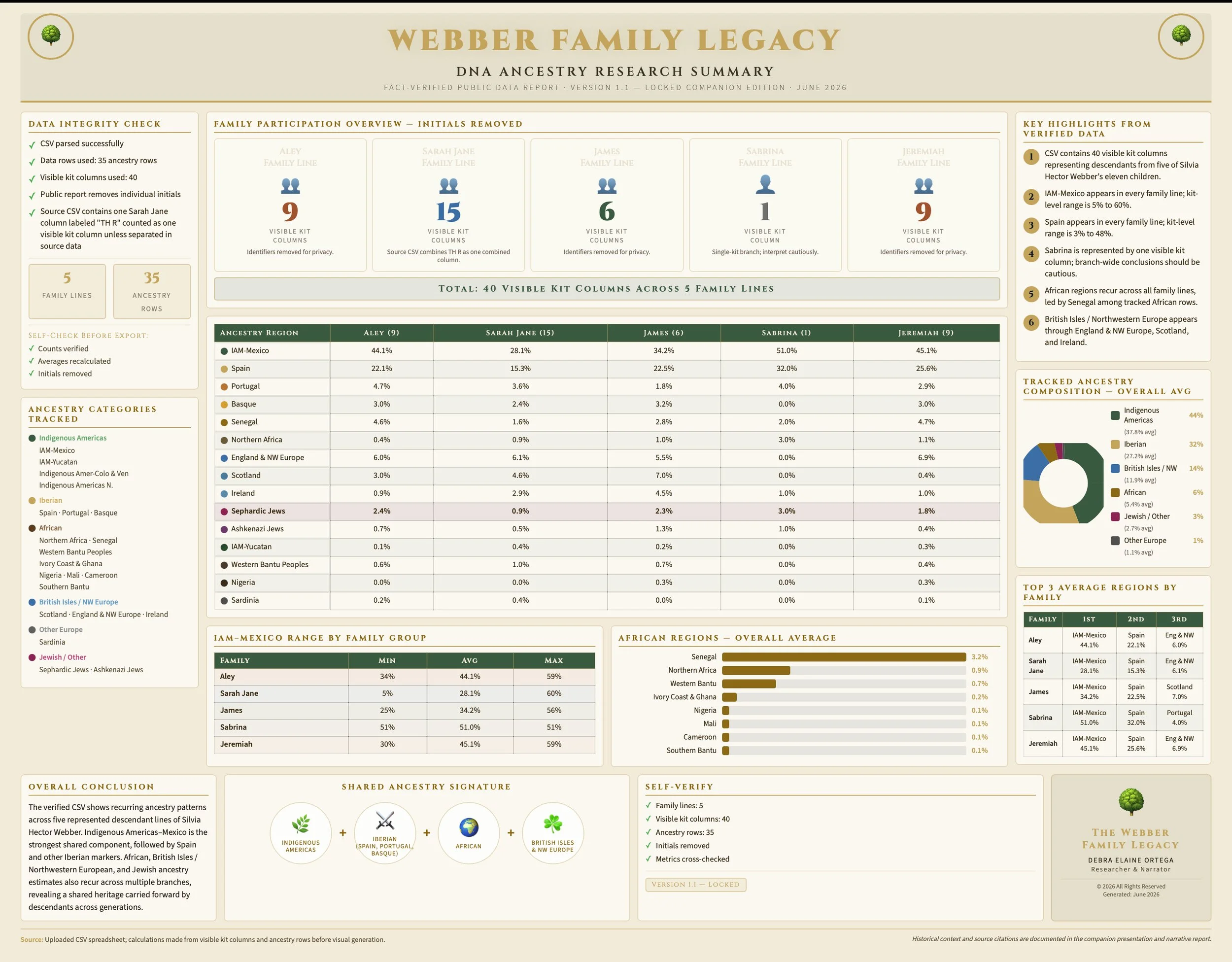
Descendant DNA testing now connects living family members back to the documented lines of this archive — corroborating on paper what the blood has carried for generations. A summary of that genetic record is being prepared for this page. The raw data remains private to protect living descendants. Opening soon.
The Archive Is a Beginning
These Documents Prove a Story
The records gathered here are the evidence beneath the narratives. Read how they were weighed, or return to the stories they make possible.
About the Archive
This archive is a curated historical collection developed to support the educational narratives presented in The Webber Chronicle. It brings together verified primary source documents relating to John Ferdinand Webber and Silvia Hector Webber, including military records, probate inventories, emancipation bonds, census records, land deeds, and pension files.
Materials are presented as non-downloadable archival exhibits accompanied by interpretive historical commentary. The archive functions as both a research resource and an educational framework, designed to support analysis, transparency, and continued study.
The purpose of this archive is threefold:
DNA Ancestry
Research Summary
A Live, Expanding Report — ongoing descendant research confirming what the historical record establishes.
What the Record and DNA Reveal
A life documented. A family preserved. A record that will not be erased.- 1.Estate of Dr. Samuel Flowers, Probate Inventory, East Baton Rouge Parish, July 9, 1816. New Orleans Public Library, Notarial Archives. Enslaved.org identifier: LSD-EVE-INV-26047.
- 2.1819 sale record: Silas McDaniel's sale of Silvia to Morgan Cryer Sr., Clark County, Arkansas Territory, for $550.
- 3.1826 arrival in Mexican Texas with the Cryer household as part of Austin's Colony migration.
- 4.Emancipation Bond of Silvia Hector and Children, executed by John Cryer, Bastrop County, June 11, 1834. Bastrop County Deed Records.
- 5.Hector-Webber DNA Report: A Live, Expanding Report. 40 kit columns across five descendant family lines. Collected and compiled for the Webber Family Legacy project. Ongoing research — updated as new data is added.
- 6.DNA ancestry estimates are statistical interpretations from consumer testing platforms. They are not definitive genealogical proof.
- 7.John Ferdinand Webber's lineage is based on documented New England records and compiled family tradition.
The Webber Family Legacy
40 DNA kits. Five family lines. One shared ancestry — confirmed across every branch. A fact-verified DNA ancestry report compiled from descendants of five of Silvia Hector Webber's eleven children — tracing the signals she carried forward across generations.