The Stories · Colorado
A Man Who Stood His Ground
A Biography of Courage and Commitment
"The land remembers what was built upon it."
— Webber Family Oral Record
IThe Choice
Many pioneer stories in Texas are told as stories of conquest—of men who claimed land, fought battles, and made names for themselves on the edge of empire.
This is not that kind of story.
This is the story of a man whose greatest act of courage was not conquest, but commitment. A man whose strength was measured not by what he took, but by whom he refused to abandon.
My name is Debra, and I am a descendant of John Ferdinand Webber and Silvia Hector Webber. My search began with a question that seemed almost impossible: How could a woman born enslaved come to possess thousands of acres of land?
The answer did not come all at once. It emerged in pieces—in brittle documents, old census pages, land records, and family memory. Each record told part of the same story: a story of love made public in a world built to deny it. A story of family chosen again and again despite danger, law, and social punishment.
John Webber's life matters not simply because he had a family across racial lines, but because he stood by them openly, repeatedly, and at great cost—a cost this account does not look away from, even where that cost was meant to fall on others.
His courage was not a single dramatic act. It was a lifetime of choosing them.
IIThe Making of a Man
John Ferdinand Webber was born in Vermont in 1794. He served as a private in the 31st U.S. Infantry during the War of 1812 and later journeyed to Mexican Texas. On the frontier, he acquired the nickname "Doctor" through practical experience and reputation rather than formal credentials.
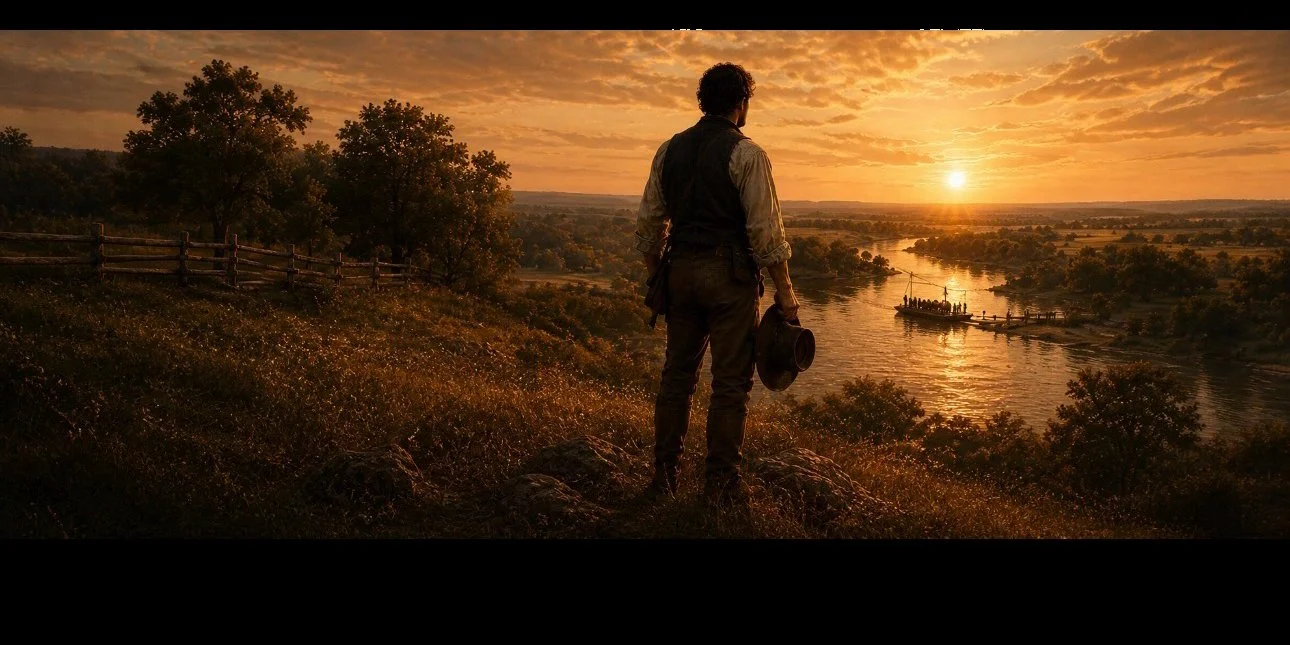
He settled along the Colorado River and built one of the earliest fortified homes in what became Travis County. The place would come to be known as Webber's Prairie.
But the truest test of his character would come not in building a fort, but in building a family.
IIIThe Defining Choice
In Texas, John met Silvia Hector, a woman born enslaved around 1807 in Spanish West Florida.
He could have hidden her. He could have denied their children. He could have protected his position.
He did not.
On June 11, 1834, John Ferdinand Webber secured Silvia's freedom and the freedom of their three children through an emancipation bond. The bond records that John Cryer performed the act of manumission, and that Webber, in exchange, bound himself and his land to a debt owed to Cryer. That debt was not measured in money alone. Webber pledged half his league of land as security, and the bond obligated him to deliver two other enslaved children—a girl to Polly Odum and a boy to Cryer himself—by a fixed date.
This is not a footnote to the story. It is the story's hardest fact: the same system that had enslaved Silvia was the system Webber used to free her. The bond made its demand in slavery's own terms — the bodies of two other children. That demand was never met: the children were never delivered, and the pledged land was forfeited to Cryer instead. The asking remains part of the record even though the price went unpaid.
He turned property into freedom for his own family. He turned land into their protection. He put his future at risk so that his family might have one—and he did so without stepping outside the logic of the world that had made Silvia's bondage possible in the first place.
Both of these things are true. This account holds them together rather than choosing between them.
IVA Life of Daily Defiance
By the late 1830s, John and Silvia lived openly as husband and wife. Their home became known for generosity. Travelers were fed. The sick were cared for. Neighbors found refuge.
The 1850 federal census, taken in Travis County on August 29 of that year, confirms this openness in the official record: John F. Webber, 64, born Vermont; Silvia, 43, recorded with the racial designation "B," born Florida; and nine children—Eley, Henry, Leonard, Sarah, James, Wilson, Salvina, Andrew, and Amanda—ages 1 to 22, all born in Texas, all recorded beneath their parents in the same household. Also present that day were John McDivit, 48, of Pennsylvania, and Robert Gill McAdoo, 37, a schoolteacher from North Carolina—evidence that the family's long-held memory of educating their children privately, even amid hostility, has a documentary basis.
No disguise. No apology. In a world built on silence, honesty itself became resistance.
VA Strategic Retreat, Not a Surrender
As Texas hardened into a slave society, danger increased. The Webbers moved south to the Rio Grande Valley near present-day Donna.
Leaving was not weakness. It was survival.
Family memory holds that their ferry helped others cross into Mexico, where slavery had been abolished.
Again and again, John chose his family.
VIA Legacy Forged in Ink and Iron
Land records, brand books, and census pages reveal continuity. By 1870, John was surrounded by Silvia, children, and grandchildren.
The family endured.
Epilogue: The Ground He Stood On
John Ferdinand Webber died on July 19, 1882.
He is remembered not because he lived without fear, but because fear did not govern his choices. He chose conscience over comfort. He chose family over status. He chose loyalty over approval.
He also, in securing that loyalty, agreed to terms this account will not soften: a bond that demanded two other enslaved children in the same currency that had been used against Silvia. He never delivered them — the land he pledged was forfeited instead — but the willingness to sign such terms remains part of the record. Remembering him honestly means holding both truths: the man who never abandoned his family, and the man whose rescue of them was entangled with a cost meant to fall on others.
He chose them. He stood by them. And because he did, the story survived.